The highest-paying healthcare jobs in the UK are senior clinical and surgical specialist roles. Medical directors, consultants, surgeons, and GPs can earn £150,000 to £200,000 or more each year through NHS consultant pay, private practice, and locum work combined.
That is just the top tier, though. Healthcare offers strong earning potential at almost every level. A newly qualified care assistant might start on just over twenty thousand pounds a year, while a registered nurse or pharmacist can build a steady six-figure career over time. So where does your future career fit into this picture? This guide breaks down the highest-paying jobs in the UK, along with the qualifications and courses that can get you there.
The Highest Paying Healthcare Jobs in the UK at a Glance
Healthcare pay in the UK depends on your role, your training path, and where you work. The table below shows verified salary ranges across the roles covered in this guide.
Some healthcare roles stand out for their earning potential. These fall into three broad groups. Each group reaches high pay through a different route.
Medical and Specialist Clinical Roles
Doctors and surgeons rank first in the list of earners in the healthcare sector. The category includes general practitioners, consultants, and other specialists such as cardiologists and surgeons. The high earnings of doctors and surgeons can be attributed to years of education that they have undergone. The amount is also due to the huge responsibility that they bear on a daily basis.
Salary Figures
NHS consultants earn a basic salary of £113,565 to £150,569. Pay depends on their years of service. Salaried GPs earn £78,699 to £118,759. Once you add private practice, on-call supplements, and clinical excellence awards, many consultants and GPs clear well over £150,000 a year.
Senior Healthcare Management and Leadership Roles
Not all top earners within the health sector have contact with patients. Medical directors, hospital chief executives, and other high-level individuals manage the entire department or trust. They take responsibility for managing budgets, staff, and clinical standards within big organisations. These positions require years of experience in the healthcare field. Additionally, they demand good leadership skills.
Salary Figures
Medical Directors typically earn £120,000 to £160,000 or more. This falls under the NHS Very Senior Manager pay framework. Hospital CEOs can earn anywhere from £150,000 to £250,000 or more. It all depends on the size and complexity of the trust or organisation.
Registered Healthcare Professionals
These professions are essential in patient care. There is a need for a recognised degree to practice in these professions. Professional registration is also necessary before one can begin practising. Remuneration increases steadily with time due to the NHS banding system.
Salary Figures
Registered nurses and midwives start on £31,049 at Band 5. They can reach £37,796 before moving into Band 6 and beyond. Pharmacists earn £38,682 to £54,710 at Bands 6 to 7. Senior hospital pharmacists can climb into even higher bands.
Which Healthcare Jobs Pay Well Without a Medical Degree?
You do not need years of medical school to build a solid career in healthcare. Several roles offer steady pay, real progression, and the chance to grow into more senior positions over time. These roles are also often the starting point for people entering the sector from a completely different background.
Healthcare Assistant
Healthcare assistants assist nurses and doctors in providing daily care for patients. Tasks include assisting patients with personal hygiene and taking vitals. Patients who have problems walking also receive assistance from healthcare assistants. The job is part of the NHS Agenda for Change banding system, which provides progression opportunities for further education.
Salary Figures
Healthcare assistants typically earn £24,937 to £26,598 under Band 3 of the NHS pay scale.
Healthcare Support Worker
Healthcare support workers carry out similar duties to healthcare assistants, often within hospital wards or specialist departments. Some roles focus on a particular area, such as mental health or maternity support. Experience in this role can open the door to assistant practitioner or nursing associate positions.
Salary Figures
Pay for healthcare support workers generally falls between £25,760 and £27,476, in line with Band 3 of the NHS pay scale.
Care Assistant / Care Worker
Care assistants and care workers support people in residential homes, nursing homes, or their own homes. The work includes personal care, helping with daily routines, and offering emotional support. Pay in this area depends heavily on the employer and the setting.
Salary Figures
According to the latest workforce metrics fromSkills for Care, adult care assistants in the UK typically earn between £21,000 and £28,000 a year depending on their location and employer.
Support Worker
Support workers help people with disabilities, mental health needs, or long-term conditions to live more independently. The role often involves working closely with families and other professionals to build a person-centred care plan.
Salary Figures
Support worker pay usually sits in a similar range to care assistants, around £21,000 to £32,000 a year, with variation across employers.
Domiciliary Care Worker
Care at home is provided by carers who attend the houses of those they are helping. They are also sometimes known as home care workers. Their responsibilities may also involve providing personal and medication assistance. They also provide companionship. Live-in care in this sector is likely to be paid more due to the long working hours and increased responsibility involved.
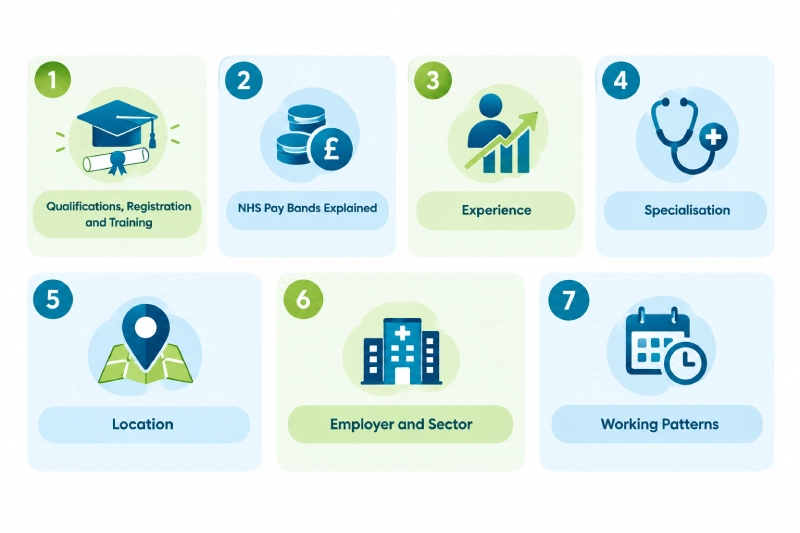
What Factors Affect Healthcare Salaries in the UK?
Your position alone does not determine your earnings in healthcare. Various determinants come into play and help create your earnings. It is important to understand them so as to be able to develop an effective career strategy.
Qualifications, Registration and Training
These are the factors that determine your starting salary levels. A qualification such as a diploma, professional membership, or special certification automatically places you on a higher level of pay. You will need further training and CPD to move up the levels. It may also get you a better position.
NHS Pay Bands Explained
The majority of positions in the NHS fall under the Agenda for Change pay scheme. The Agenda for Change scheme employs bands that range from band 2 to 9. Band 2-9 consists of various pay points. With increasing responsibilities and experience, you advance through your band’s pay points. In the end, you will be able to move up to another band.
Salary Figures
Band 3 roles such as healthcare assistants start around £25,760. Band 5 roles like newly registered nurses start at £32,073. Band 7 roles, often held by senior specialists or team leaders, reach up to £49,387. Bands 8 and 9 cover senior management and highly specialist clinical roles, often exceeding £112,782.
Experience
Experience is among the most significant motivators for better compensation in healthcare. Upgrading to a more senior role from an entry-level job may lead to a substantial salary hike. The same applies when it comes to specialist and managerial roles, where some employers might prefer hands-on experience to formal education.
Specialisation
Focusing on areas where there is more demand generally results in a higher salary. This is even truer in cases where professionals are few and far between. Mental health, critical care, and speciality surgical procedures generally pay well. The shortage keeps pushing salaries higher in these areas. Being able to develop skills in a specialised area will be an advantage for you.
Location
Location plays an important role when considering your salary in the UK. London and the South East pay better than other places. The reason behind this is the cost of living and competition for employees there. Other areas might provide relocation benefits in order to lure healthcare workers to the area.
Salary Figures
NHS staff working in Inner London can receive a High Cost Area Supplement worth around 20 per cent on top of their basic salary, subject to a minimum and maximum Cap. Outer London and fringe areas receive a smaller uplift.
Employer and Sector
If you’re working at the NHS, in a private hospital, or at social care establishments, your pay structure will differ completely. The NHS provides standard bands, good pension schemes, and career progression, while private employers usually determine their own pay scales. They might be better for senior or specialist positions but offer fewer defined benefits.
Working Patterns
When you choose to work, as well as how you work, also plays a part in determining what your income is. There are often times some additional bonuses associated with night time, weekend, and on-call working. These could be different depending on whether you are full-time, part-time, or agency working.
NHS vs Private Healthcare: Does One Pay More?
This is one of the most common questions people ask when planning a healthcare career. The honest answer depends on your role and stage of career.
Factor
NHS
Private Healthcare
Pay structure
Fixed bands, predictable progression
Employer-set, varies widely
Entry-level and mid-career pay
Steady and standardised
Similar or slightly lower on average
Senior and specialist pay
Strong, but capped by pay frameworks
Often higher, especially for consultants and surgeons
Pension
Strong NHS pension scheme
Varies by employer
Job security
High
Depends on employer and contract type
Additional earning potential
Limited outside NHS pay scales
Private practice, bonuses, and equity in some senior roles
In short, the NHS tends to win on stability and structure, while private healthcare tends to win on ceiling, particularly for senior specialists.
What Courses Can Help You Prepare for a Healthcare Career?
Formal qualifications open the door to healthcare roles, but ongoing courses keep your career moving forward. Whether you are just starting or aiming for a more senior position, the right course can make a real difference to your pay and your progression.
Continuing Professional Development
The term ‘Continuing Professional Development’ or CPD is a process that helps health professionals maintain their skills and knowledge throughout their careers. Employers consider CPD to be an indication of genuine commitment to learning and genuine care for patient care. Most positions at senior levels and salary increments depend on the completion of CPD activities.
Role-Specific Healthcare Courses
In addition to the general CPD training courses, there are some that are needed for certain positions. They include training in infection prevention and control, safeguarding, medication management, and dementia care. These training courses serve as a foundation and can also open up opportunities for more senior and better-paid positions in the future.
HCA London offers a range of CPD-certified, role-specific courses covering exactly these areas. The courses are flexible and self-paced, making them a practical way to build the skills employers look for without stepping away from your current job.
What Is the Care Certificate and Why Is It Important?
The Care Certificate is a set of standards outlining the core knowledge, skills, and behaviours expected of frontline health and social care workers in the UK. It was developed jointly by Skills for Care, Skills for Health, and NHS England, and it serves as a baseline induction framework for the sector.
Key Features
It is employer-led rather than an Ofqual-regulated qualification, so practical competence must be assessed and signed off in the workplace.
It is designed for new or returning health and social care support workers.
The certificate belongs to the individual and is recognised across UK employers, so it stays valid if you change jobs.
The Care Quality Commission expects providers to use these standards as part of staff induction.
The 16 Care Certificate Standards
The framework covers 16 distinct standards in total, including a standalone standard focused on learning disabilities and autism. Together, the standards cover core areas such as roles and responsibilities, safety, safeguarding, and health.
Qualification Alternative
For those who want a formally accredited option, the government also supports a regulated Level 2 Adult Social Care Certificate, which is mapped against the same 16 standards. Healthcare Academy (HCA London) offers a Care Certificate course built around these standards, giving learners a flexible way to complete their induction training.
Can Healthcare Assistants Progress to Higher-Paying Healthcare Roles?
Starting as a healthcare assistant does not mean staying there forever. Many healthcare assistants build long, well-paid careers by moving up through a clear progression path. Here is what that path usually looks like.
Healthcare Assistant or Support Worker
Experience and workplace learning
Additional skills and CPD
Senior responsibilities
Further qualifications or specialist skills and continued learning
Advanced, specialist, or management pathways
Most healthcare assistants build experience first. They add CPD courses next. This helps them stand out for senior roles. Many move into senior healthcare assistant, assistant practitioner, or nursing associate positions. Some go on to a nursing degree. Others step into management roles.
What Skills Are Important for a Healthcare Career?
Qualifications open the door to healthcare roles. Skills keep you there and help you grow. These five areas matter across almost every healthcare job.
Communication
Clear communication builds trust with patients and colleagues. It helps you explain care plans simply. It also reduces mistakes during handovers and daily tasks.
Patient Care
Good patient care goes beyond tasks on a checklist. It means noticing small changes in someone’s condition. It also means treating every patient with dignity and patience.
Teamwork
Healthcare rarely works well in isolation. Most roles depend on close teamwork across shifts and departments. Strong teamwork keeps care consistent and safe.
Safeguarding
Safeguarding protects vulnerable patients from harm or neglect. Every healthcare worker needs to spot warning signs early. Reporting concerns quickly can make a real difference.
Continuing Learning
Healthcare changes constantly through new guidance and best practice. Workers who keep learning stay ready for these changes. This also keeps their skills relevant for higher-paying roles.
Which Healthcare Career Could Be Right for You?
With so many paths available, choosing the right one can feel overwhelming. Thinking about what matters most to you can help narrow things down.
If You Want…
Consider This Path
To start working quickly and build experience on the job
Healthcare Assistant or Support Worker
Hands-on patient care with a clear qualification pathway
Nursing or Midwifery
Leadership and organisation over clinical work
Healthcare Management
The highest earning potential, with years of training
Medicine or a Surgical Speciality
Steady progression with a good balance of stability and growth
Pharmacy or Allied Health Roles like Physiotherapy
There is no single right answer here. The best path is the one that matches your interests, your timeline, and how much training you are ready to commit to right now.
Final Thoughts
Healthcare offers real earning potential at every stage. Entry-level roles like healthcare assistant and support worker sit at the start. The top-paying healthcare jobs in the UK sit at the other end, held by consultants, GPs, and senior leaders. They can clear £150,000 to £200,000 once private work and added responsibility come into play. Wherever you start, the path forward stays the same. Build experience. Add skills through focused training. Take on more responsibility as you grow. Your income will follow.
Medical directors, consultants, surgeons, and GPs top the list. Senior healthcare managers and hospital CEOs also earn strong salaries. Pharmacists and senior nurses follow close behind.
Registered nurses stay in high demand across the NHS and private sector. Healthcare assistants and care workers are also needed constantly. Mental health roles face some of the biggest shortages right now.
Senior physiotherapists and paramedics earn strong salaries with experience. Radiographers and occupational therapists follow close behind. Pay grows steadily as these roles move up the NHS bands.
Surgeons and specialist consultants earn the most among doctors. This includes fields like orthopaedics, cardiology, and plastic surgery. Private practice often adds a large boost on top of NHS pay.
Pharmacists and advanced nurse practitioners earn strong salaries without a medical degree. Senior healthcare managers also reach high pay through experience. These roles offer real progression without years of medical school.