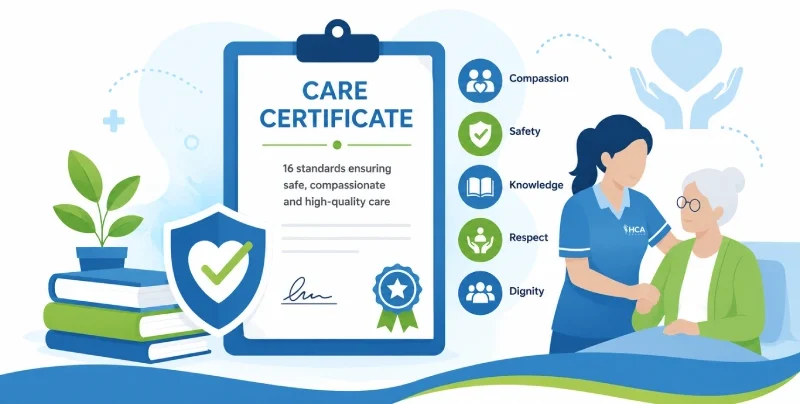
The Care Certificate is a recognised set of 16 standards for people working in health and social care. It gives new care workers the essential skills, knowledge, and behaviours they need to provide safe, compassionate, and high-quality care.
It also introduces the key responsibilities expected in everyday care roles. The certificate helps employers ensure that every worker meets the same standard before taking on their role independently.
In this guide, you will learn what the Care Certificate is, why it matters, and how it supports your career. You will also discover how quality training helps you succeed in the care sector.
Understanding the Care Certificate
The Care Certificate is a workplace programme for people who are new to health and social care. It builds the essential knowledge, practical skills, and professional behaviours needed for safe and effective care. As a result, new care workers gain confidence from the start.
NHS England, Skills for Care, and Skills for Health have designed the Care Certificate to define standards within the care industry. Several organisations have made it part of their induction programmes. Learners have the opportunity to learn essential skills at work and receive support from expert mentors.
The Care Certificate focuses on practical learning rather than classroom-based learning. It also encourages learners to be dignified and respectful, communicate effectively, and provide person-centred care. As a result, you will cultivate professional behaviours that lead to enhanced quality of care.
Start Your Career in Care with Confidence
Start your care journey with training that helps you understand the role and feel more ready for real workplace situations. Our Care Certificate Courses give you a practical foundation for working in care.
Study around your routine, build useful knowledge, and take your next step with greater confidence.
The Care Certificate gives new care workers a strong foundation for providing high-quality care. It also helps employers maintain high standards across their teams.
Builds practical skills for everyday care. It improves communication, teamwork, and safe working practices. As a result, new care workers feel confident in their roles.
Improves patient safety through infection prevention, safeguarding, and health and safety practices. Therefore, it helps learners identify risks early and provide safer care every day.
Provides consistent standards within healthcare and social care environments. All learners have the same standards to live up to, hence improved teamwork and service delivery.
Boosts confidence in the work environment through feedback. As a result, learners execute their tasks with more confidence and make better judgments.
Supports long-term career growth and professional development. It also strengthens your CV, improves job opportunities, and prepares you for future qualifications.
Who Needs the Care Certificate?
For anyone entering health and social care, understanding what is the Care Certificate can help explain its value. The programme helps new care workers build confidence and prepare for their daily responsibilities. Therefore, many employers include it as part of their induction process because it helps new staff follow safe and consistent care practices. It is suitable for people working as:
Healthcare Assistant
Care Assistant
Support Worker
Home Care Worker
Residential Care Worker
Domiciliary Care Worker
Adult Social Care Worker
Even if your employer does not make it a requirement, completing the Care Certificate demonstrates your commitment to professional growth. It also shows that you value safe, high-quality, and person-centred care.
What Are the 16 Care Certificate Standards?
The Care Certificate includes 16 national standards. Each standard focuses on an essential area of care. Together, they prepare workers to deliver safe, compassionate, and person-centred support. The table below gives a quick overview of every standard.
Standard 1
Understanding Your Role
Standard 2
Your Personal Development
Standard 3
Duty Of Care
Standard 4
Equality, Diversity, Inclusion and Human Rights
Standard 5
Work in a Person-Centered Way
Standard 6
Communication
Standard 7
Privacy and Dignity
Standard 8
Fluids and Nutrition
Standard 9
Awareness of Mental Health and Dementia
Standard 10
Adult Safeguarding
Standard 11
Safeguarding Children
Standard 12
Basic Life Support
Standard 13
Health and Safety
Standard 14
Handling Information
Standard 15
Infection Prevention and Control
Standard 16
Awareness of Learning Disability and Autism
The Impact of Care Certificate Standards on Your Career
Many learners ask, what does a Care Certificate give you? It gives you the confidence, understanding, and workplace abilities needed to provide safe and effective care. In addition, each standard supports daily care practice and helps you communicate well, work safely, and provide person-centred support. As a result, you become more confident in your role and make better decisions every day.
Meeting all 16 standards demonstrates your dedication to safe, empathic, and professional practice. This will also help you earn the trust of patients, their families, and your employer. Moreover, this confidence comes from workplace experience and skill development that help you throughout your career. With increasing experience, you are ready for the next level of success.
How Online Learning Supports Your Care Certificate
E-learning makes the Care Certificate online experience more flexible and accessible for new care workers. You can study at your own pace and complete online modules around your work and personal commitments. Moreover, most courses allow you to access lessons, videos, and quizzes anytime, helping you understand topics easily. Many learners complete their online modules within a few weeks, depending on their schedule and progress.
However, practical workplace experience remains essential for completing the Care Certificate. Online learning helps you prepare for assessments, while hands-on practice builds confidence in real care settings. Therefore, a trusted provider can offer guidance, support, and quality resources to help you complete the programme successfully.
Final Thoughts
The Care Certificate helps new professionals begin their health and social care journey with confidence. Furthermore, knowing what is the Care Certificate helps you understand how it supports safe practice, professional growth, and career development. If you are looking for a flexible way to begin your care career, Healthcare Academy London offers a supportive Care Certificate course. With quality resources and expert guidance, you can achieve your goals with confidence. Take the next step towards a rewarding future in the care sector.