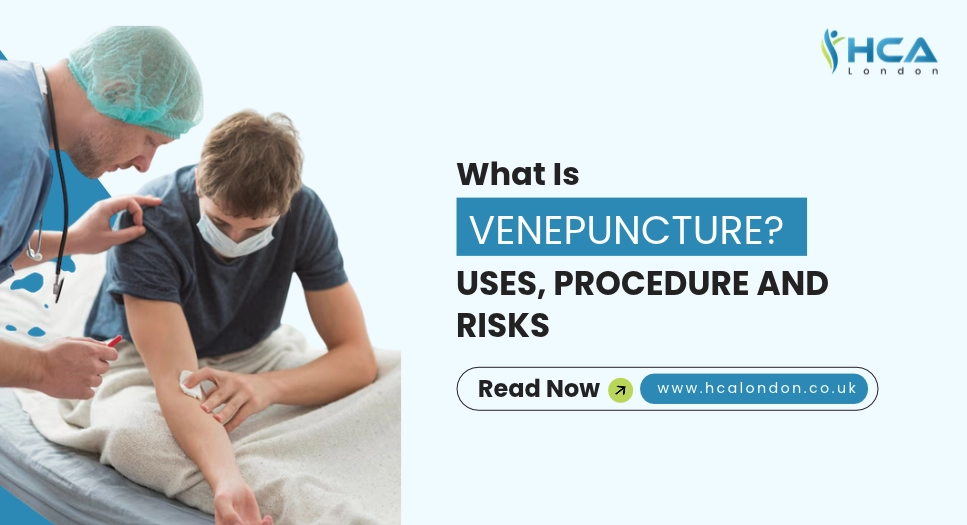
Venepuncture is a clinical procedure where a trained healthcare professional uses a sterile needle to enter a vein Venepuncture is a clinical procedure where a trained healthcare professional inserts a sterile needle into a vein. Staff use it to collect a blood sample or to give intravenous (IV) fluids and medication. So, if you are asking what venepuncture is, think of it as the first step in many blood tests and IV treatments. The laboratory then analyses any blood sample and gives clinicians valuable information.
This information matters a lot. It helps doctors diagnose conditions, monitor long-term health and check how well a treatment works. As a result, venepuncture supports many everyday clinical decisions in healthcare.
In this blog, you will learn what venepuncture is and why it is important in healthcare. You will also see how the procedure works, which equipment staff use, what risks exist and who can perform it.
Let’s begin.
What Is Venepuncture?
Venepuncture means entering a vein with a sterile needle. Healthcare professionals use it to collect blood or to deliver IV fluids and medication. People also call it a blood draw or phlebotomy, and some spell it venipuncture. First, a trained professional finds a suitable vein, usually in the arm. Then they guide the needle in. For a blood test, the blood flows into sample tubes. After that, they label each tube and send it to a laboratory. For treatment, they connect the IV line and give the fluids or medication.
How a Needle Accesses a Vein
First, the professional looks for a suitable vein. Most of the time, they choose a vein inside the elbow because it sits close to the skin and is easy to find. Next, they apply a tourniquet above the site, which makes the vein fuller and easier to see. Then they clean the skin and guide a sterile needle into the vein at a shallow angle. As soon as the needle sits inside, blood starts to flow.
How Blood Flows Into Sample Tubes
After that, the professional connects a collection tube to the needle. Many settings use a vacuum tube system, so the tube draws blood in on its own. Alternatively, some teams use a syringe and then fill the tubes. Each tube has a coloured top, which tells staff what additive it holds. For example, some additives stop blood from clotting, while others help it clot. As a result, the right tube protects the quality of the test.
What Happens to the Sample Afterwards
Once the tubes are full, the professional removes the needle and labels each tube with the patient’s details. Then the sample travels to the laboratory. There, trained staff run the requested tests on specialist equipment. Next, the laboratory sends the results to the clinician who asked for them. Finally, the clinician reads the results alongside the patient’s symptoms and history.
Venepuncture vs Phlebotomy
People often use these two words as if they mean the same thing. However, they do not always match.
Venepuncture means entering a vein, usually to take blood.
Phlebotomy is the broader practice of collecting blood samples, and it includes venepuncture.
So, every venepuncture forms part of phlebotomy, but phlebotomy can cover more than one method. Even so, many teams use both words for the same task in daily practice.
Venous Blood Collection vs Capillary Sampling
Not every blood test needs a vein. For example, a quick finger prick can give enough blood to check glucose. Staff also use a heel prick for newborn babies. Capillary sampling takes a tiny amount of blood from the small vessels near the skin. In contrast, venous collection gives a larger sample that suits many laboratory tests. As a result, clinicians choose the method that fits the test, the patient and the setting.
The table below puts these four terms side by side so that you can see the differences at a glance.
Term
What it means
Typical use
Venepuncture
Entering a vein with a needle
Collecting blood for laboratory tests
Phlebotomy
The wider practice of collecting blood
Blood sampling across healthcare settings
Venous blood collection
Taking blood from a vein
Larger samples for many tests
Capillary sampling
Taking blood from tiny vessels near the skin
Quick checks such as glucose
Why Is Venepuncture Important in Healthcare?
Blood carries clues about almost every part of the body. Venepuncture gives clinicians access to those clues. Here is how it supports care at each stage.
Diagnosing Medical Conditions
When a patient has symptoms, an examination alone often does not give the full answer. So, clinicians request blood tests that point towards a cause. For example, results can show signs of infection or inflammation. They can also reveal changes in blood cells and haemoglobin, which helps clinicians investigate anaemia. Similarly, blood glucose results support the investigation of diabetes. As a result, venepuncture gives clinicians clearer information to work with.
Monitoring Existing Health Conditions
Many people live with long-term conditions that need regular checks. In these cases, clinicians use repeat samples to follow what happens over time. For instance, they can track blood glucose and other relevant markers. They can also watch kidney, liver and thyroid-related markers for changes. Therefore, a small shift in results can prompt an early conversation with the patient.
Evaluating Treatment Effectiveness
Treatment does not work in the same way for every person. That is why clinicians check blood results while a patient takes certain medicines. These tests show how the body responds. Moreover, they can highlight laboratory changes that need further investigation. With this information, the care team can decide whether to continue, adjust or review the treatment.
Supporting Routine Health Checks
Blood tests also play a part in preventive care. During a routine check, clinicians look at relevant parts of general health. Sometimes a result falls outside the usual range, and that can lead to further investigation. Equally, repeat results over time show how health markers change. As a result, small issues can come to light before they grow.
What Is Venepuncture Used For? Common Blood Tests Explained
Venepuncture supports a wide range of blood tests. Clinicians pick each test based on the patient’s symptoms, medical history and clinical assessment. The table below shows some of the most common tests and what each one helps assess.
Blood test
What it helps assess
Full Blood Count (FBC)
Red blood cells, white blood cells, haemoglobin and platelets
Blood Glucose
Blood glucose levels at the time of testing
HbA1c
Average blood glucose over about two to three months
Thyroid Function Tests
Thyroid hormone levels and thyroid function
Urea and Electrolytes
Kidney-related markers and electrolyte balance
Liver Function Tests
Enzymes and proteins linked to liver health
Lipid Profile
Cholesterol and other blood lipids
Why Clinicians Choose Different Tests
Clinicians do not order every test for every patient. Instead, they match each test to the question they need to answer. For example, a patient who feels very tired may need a full blood count, while a patient who lives with diabetes may need an HbA1c. So, each request depends on the person in front of them.
Why Different Tests Need Different Tubes
Every test has its own tube. Each tube holds a specific additive that protects the sample for that test. Therefore, staff must choose the right tube and follow the correct collection order. A wrong tube can affect the result.
Why Some Tests Need Preparation
Some tests need a little preparation first. For instance, a clinician may ask a patient to fast before certain tests. However, patients should only fast when a clinician tells them to. For many other tests, they can eat and drink as normal.
Is Venepuncture the Only Way to Test Blood?
Not every blood test needs a vein. Some checks, such as a finger-prick glucose test, use a capillary sample instead. In these cases, staff collect a tiny amount of blood from the skin. So, venepuncture is one option among several.
How Is Venepuncture Performed? Understanding the Procedure
Every venepuncture follows four clear stages. This guide explains them for general understanding. It does not replace practical clinical training, and techniques can differ from one patient to another.
Before the Procedure
Good preparation keeps the procedure safe and calm. First, the professional checks who the patient is and what tests the clinician requested. Then they explain what will happen and ask for consent. Patient identification and consent always come first.
Confirm the patient’s name and date of birth.
Check the request form and the tests needed.
Explain each step and ask for consent.
Ask about allergies and past blood draw problems.
Gather the right equipment before starting.
Preparing for Blood Collection
Next, the professional sets up the area and protects against infection. They look for a suitable site, usually inside the elbow. Hand hygiene and personal protective equipment come before any contact with the skin. Then they clean the site and let it dry, which lowers the risk of contamination.
Choose a suitable vein that feels clear and easy to reach.
Clean hands and put on gloves.
Wipe the skin with an antiseptic wipe.
Wait until the antiseptic dries fully.
Prepare the blood collection system for use.
Collecting the Blood Sample
Now the collection begins. The tourniquet makes veins fuller, so suitable ones become easier to find. After that, the professional guides the needle into the vein and connects the tubes. The correct tubes and the right collection order matter a lot, because they protect the quality of each result.
Apply the tourniquet to make veins easier to see.
Guide the needle into the vein at a shallow angle.
Fill each tube in the correct collection order.
Follow local clinical procedures at every step.
After the Procedure
Once the tubes are full, the professional finishes the job with care. They remove the needle safely and press on the site until the bleeding stops. Next, they dispose of the sharps straight away. Finally, they label every sample correctly, because a mislabelled tube can lead to serious errors.
Release the tourniquet and remove the needle safely.
Press on the site until bleeding stops.
Dispose of sharps in a sharps container at once.
Label the sample and check that the details are correct.
Handle and send the sample to the laboratory correctly.
What Equipment Is Used for Venepuncture?
Venepuncture needs a small set of tools. Each item has a clear job, and every item helps keep the patient and the sample safe. The table below lists the usual equipment and what each piece does.
Equipment
Purpose
Tourniquet
Helps make suitable veins easier to identify
Sterile blood collection needle or device
Provides access to the vein
Blood collection tubes
Collect and contain blood samples
Gloves
Provides a protective barrier
Skin antiseptic
Helps reduce contamination risk
Gauze or cotton wool
Applies pressure after needle removal
Sharps container
Safely disposes of used needles and sharps
Clinical waste container
Allows appropriate disposal of relevant clinical waste
Dressing or adhesive plaster
Protects the puncture site after collection
Why Equipment Choice Can Change
Not every patient needs the same setup. The collection method, the patient’s circumstances and the clinical setting all play a part. For example, some teams use a vacuum tube system, while others use a syringe. Likewise, a patient with small or fragile veins may need a different type of collection device. So, trained staff choose the equipment that fits each situation.
Why Sterile and Single-Use Items Matter
Clean equipment protects everyone in the room. Sterile and single-use items lower the risk of infection and contamination. Staff also check that every pack is sealed and in date before they open it. As a result, the sample stays reliable, and the patient stays safe.
What Are the Risks and Possible Complications of Venepuncture?
Venepuncture is a common and generally safe procedure. Even so, a few minor effects can happen. Most settle quickly, and trained staff know how to respond. Here is what to expect.
Bruising
Bruising is the most common effect. It happens when a small amount of blood leaks under the skin near the puncture site. As a result, a mark can appear in the hours after the procedure. Pressing firmly on the site afterwards helps lower the chance. In most cases, the bruise fades on its own within a few days.
Mild Pain or Discomfort
Some people feel a short sting when the needle enters the skin. However, the feeling usually passes within seconds. Everyone reacts differently, so some people notice it more than others. Relaxing the arm and breathing slowly can help. Staff will also check in with you, so you can tell them how you feel.
Bleeding
A little bleeding can happen when the needle comes out. Staff press on the site straight away to stop it. In most cases, the bleeding settles within a few minutes. However, some people bleed for longer, for example, those who take blood-thinning medicines. So, always tell staff about any medicines you take.
Haematoma
A haematoma forms when blood collects under the skin and causes a firm, swollen lump. It can look like a larger bruise. Staff may see one if the vein leaks after the needle comes out. Most haematomas are small and fade over time. Even so, the area may feel tender for a few days.
Infection
Infection is uncommon. Staff lower the risk with clean hands, skin preparation and sterile, single-use equipment. So, when teams follow these steps, problems rarely arise. Still, keep an eye on the site in the days after. Redness, warmth or discharge needs medical advice.
Dizziness or Fainting
Some people feel dizzy or faint during or after blood collection. This often happens through a vasovagal reaction, where the body responds strongly to the needle or the sight of blood. As a result, blood pressure can dip for a short time. Warning signs include sweating, pale skin and a light head. Lying down quickly usually helps these feelings pass.
When Should You Seek Medical Advice?
Most people feel fine afterwards. Even so, certain signs need attention from a healthcare professional. Contact one if any of the following happens.
Bleeding keeps going after pressing on the site.
Swelling grows larger over the following hours.
Pain gets worse instead of better.
Redness, warmth or discharge appears at the site.
How Patients Can Prepare
A little preparation makes the experience smoother. Before the procedure, a few simple steps can help.
Tell staff if you have fainted during blood tests before.
Share any worries early so that staff can support you.
Follow any preparation instructions you received, such as fasting.
Ask to lie down if you tend to feel faint.
How Can Healthcare Professionals Make Venepuncture Safer?
Safe venepuncture depends on good habits, not luck. Skilled professionals follow the same core principles every time, whether the day is quiet or busy. Here are the ten that matter most, and the sections below explain how each one works in practice.
Check the patient’s identity before every collection.
Explain the procedure and respect the patient’s decision.
Clean hands and skin to lower the risk of infection.
Use sterile, single-use equipment for every patient.
Follow the correct collection and handling steps for each sample.
Label every sample accurately and straight away.
Place used needles directly into a sharps container.
Talk clearly and respond to the patient’s worries.
Consider each patient’s needs and any past difficulties.
Work only within your training, role and authorisation.
Putting the Patient First
Safety starts before the needle comes out. The professional confirms who the patient is and asks them to state their name and date of birth. Next, they explain the procedure, ask for consent and respect the patient’s decision. They also listen to worries and ask about past difficulties, such as fainting or fragile veins, so that they can plan the safest approach.
Protecting Against Infection and Injury
Infection prevention protects both the patient and the professional. Staff clean their hands, put on gloves and clean the skin before they begin. Then they open a sterile, single-use device in front of the patient and never reuse equipment. Once the sample is done, they place the used needle straight into a sharps container without recapping it.
Protecting the Sample
A safe procedure also gives a reliable sample. Professionals choose the right tube for each test and fill the tubes in the correct order, because the additives can mix and affect the result. They handle the tubes gently and label each one straight away in front of the patient. Finally, they send the sample following local rules, so it reaches the laboratory in good condition.
Working Within Your Role
Safe practice means knowing your limits. Professionals only perform venepuncture with the right training, proven competence and workplace authorisation. When something feels unclear, they pause and ask a colleague for help. They also report any incident or near miss, so the whole service learns and stays safer.
How Pre-Analytical Errors Affect Results
Some mistakes happen before the sample even reaches the laboratory. Experts call these pre-analytical errors. Examples include a wrong patient identity, a contaminated sample and poor handling during transport. Even a small slip can change a result. As a result, a clinician may read the wrong result and make a poor decision.
The table below shows common errors, what can go wrong and how staff prevent each one.
Error
What can go wrong
How staff prevent it
Wrong patient identity
Results belong to someone else
Check name and date of birth
Missing or wrong label
Laboratory rejects the sample
Label straight away at the bedside
Contamination
Germs change the result
Clean skin and use sterile equipment
Wrong tube
Additive does not suit the test
Match the tube to the request
Rough handling or delay
Blood cells get damaged
Handle gently and send on time
Who Can Perform Venepuncture?
Several healthcare professionals can perform venepuncture. However, the right to do so depends on three things. These are the person’s role, their workplace policy and the professional requirements that apply to them. So, no single job title gives automatic permission.
Phlebotomists
Phlebotomists specialise in blood collection. They take samples for laboratory tests in hospitals, clinics and community settings. Because they perform the task every day, they build strong practical skills. They also focus on patient comfort, correct labelling and safe sample handling. As a result, many services rely on them for routine blood tests.
Registered Nurses
Venepuncture can form part of a registered nurse’s clinical duties. Nurses often take blood while they assess and care for patients. Even so, they must have the right training and prove they are competent first. Their employer also needs to allow them to carry out the task. So, a nurse works within these limits every time.
Doctors
Doctors may also perform venepuncture as part of patient assessment and care. For example, a doctor may take a sample during a busy clinic or an urgent review. They still follow the same safety rules as everyone else. That includes patient identification, consent and infection prevention. Therefore, the standard stays the same, whoever holds the needle.
Healthcare Assistants and Other Practitioners
Some healthcare assistants and other practitioners can take blood too. However, this only applies when the task falls within their delegated duties. They also need the right training, proven competence and workplace authorisation. Without all three, they should not carry out the procedure. In practice, each employer sets its own rules, so staff should always check local policy first.
Training, Competence and Authorisation Explained
People often mix these three terms up. Yet each one means something different, and all three matter. The table below shows how they differ.
Term
What it means
Training
Learning the knowledge and instruction needed for the procedure
Competence
Showing you can perform the procedure safely in practice
Authorisation
Having permission to perform it within your workplace and professional rules
Finishing an online course does not give anyone authorisation on its own. A course builds knowledge, but practical assessment shows real competence. After that, the employer decides whether to authorise the person. So, learners should always confirm what their workplace requires before they take on this task.
What Skills Are Needed to Perform Venepuncture?
Safe venepuncture takes more than a steady hand. It needs knowledge, practical skill, good communication and a strong sense of responsibility. Here is how these four areas work together.
Clinical Knowledge
Good practice starts with understanding. Professionals need to know how veins sit in the arm and why some veins suit blood collection better than others. They also need to understand their equipment and the basics of infection control. This knowledge helps them make safe choices in real situations.
Learn the basic anatomy of veins in the arm.
Understand how each piece of equipment works.
Know the core steps of infection prevention and control.
Handle blood samples with care from start to finish.
Practical Skills
Knowledge only helps when someone can use it. Practical skills turn theory into safe Action. For example, a skilled professional finds a suitable vein quickly and handles the needle with control. They also collect and dispose of materials correctly. With practice, these steps become smooth and calm.
Prepare the patient and the equipment before starting.
Spot suitable veins and avoid unsuitable ones.
Handle needles and devices safely at every step.
Collect samples correctly and dispose of waste properly.
Communication and Patient Care
Many patients feel nervous before a blood test. Because of this, how a professional speaks matters as much as how they work. Clear words and a calm tone help people relax. Good communication also builds trust, which makes the whole experience easier for everyone.
Explain the procedure in clear, simple words.
Ask for consent and respect the answer.
Reassure anxious patients with a calm voice.
Listen to concerns and respond with care.
Professional Responsibility
Skill always comes with responsibility. Professionals must know their limits and stay within them. They also protect patient privacy and follow the rules of their workplace. When they feel unsure, they pause and ask for help rather than guess.
Stay within your scope of practice at all times.
Protect patient confidentiality in every situation.
Follow clinical policies and local procedures closely.
Ask for help when something feels unclear.
Reading about venepuncture gives a strong start, but it cannot replace hands-on learning. Theory needs practical training, and practical training needs a proper competency assessment. Together, they show that a person can perform the procedure safely.
What Is the Difference Between Venepuncture and Cannulation?
Venepuncture and cannulation both involve a vein, so people often mix them up. However, they are two different procedures. Each one has its own purpose, equipment and use in patient care.
What Is Venepuncture?
Venepuncture means entering a vein with a sterile needle to collect blood. Once the tubes are full, the professional removes the needle. Laboratories then use the sample to run tests that guide diagnosis and care. So, the aim is simple. Staff take blood out for testing.
What Is Cannulation?
Cannulation means placing a thin, flexible tube called a cannula inside a vein. A needle guides the cannula in, and then staff remove the needle. The cannula stays in place for as long as the patient needs it. As a result, clinicians can give fluids or medicines straight into the bloodstream. So, the aim is the opposite. Staff put treatment in.
What Both Procedures Share
Both procedures give access to a vein. In both cases, a trained professional cleans the skin, finds a suitable vein and uses a sterile needle. They also follow the same safety rules, such as patient identification, consent and infection prevention. Still, the similarities end once the needle sits in the vein.
How the Two Procedures Differ
The main difference comes down to purpose. Venepuncture collects blood, while cannulation opens a route into the vein for treatment. The table below shows how they compare.
Venepuncture
Cannulation
Involves accessing a vein, commonly to collect blood
Involves inserting a flexible cannula into a vein
Uses a blood collection needle or device
Uses a needle to guide the cannula in, then staff remove the needle
Commonly gives a blood sample for diagnostic tests
Commonly gives intravenous access for fluids or medicines
Staff remove the collection device once sampling ends.
The cannula stays in place for its clinical use
When Clinicians Use Each One
A clinician chooses the procedure that fits the patient’s needs. For example, a patient who needs a blood test will have venepuncture. A patient who needs fluids or medicines through a vein will have a cannula. Some patients need both, but staff treat them as separate steps. So, never think of the two as the same procedure.
What Should You Look for in Venepuncture Training?
Not every course gives the same value. Some focus only on theory, while others add real practice. So, a little checking before you enrol saves time and money. Here is what a good course should offer.
What a Good Course Should Teach
A strong course covers the knowledge behind the procedure, not just the steps. It should explain how veins work and how the equipment fits together. It should also teach safety, communication and sample care. With this foundation, learners understand why each step matters.
Venous anatomy and the common sites used for collection.
Equipment, procedure and the correct order of collection.
Infection prevention and clear safety principles for patients.
Patient communication, consent and ways to keep people calm.
Specimen handling, labelling and identification from start to finish.
Why Supervised Practice Matters
Reading about blood collection is not the same as doing it. Practical learning lets you build skill in a safe setting. An experienced trainer can watch your technique and correct small habits early. As a result, you grow in confidence before you work with real patients.
Practise the steps on training aids with a trainer nearby.
Receive honest feedback from someone with clinical experience.
Complete an assessment of your practical skills, where applicable.
Why Clear Course Information Matters
Good providers are open about what they offer. Look for a clear list of topics, the intended audience and the learning outcomes. Check what the course includes and what it leaves out. For example, ask whether it covers practical assessment or only theory. These answers help you set the right expectations from day one.
Theory, Practice and Authorisation Stay Separate
A course can build your knowledge and your skills. However, only your workplace can authorise you to perform venepuncture. So, always confirm your employer’s rules before you rely on any certificate. That way, you avoid surprises later.
Explore Venepuncture and Cannulation Training with HCA London
Understanding venepuncture takes more than knowing how blood is collected. It also needs knowledge of venous anatomy, patient safety, infection prevention, equipment and professional responsibilities. If you want to build that knowledge, Healthcare Academy London offers training that can support your next step.
Who the Courses Are For
Both courses suit beginners, so you do not need prior experience. They also help anyone who wants to refresh existing knowledge. Employers can use them to train staff too.
What the Venepuncture Course Covers
The Venepuncture Course runs for about one hour and thirty minutes. It focuses on the essential principles of blood collection. Here is what learners work through.
Understand why venepuncture matters in diagnosis and patient care.
Explore how the circulatory system and blood vessels work.
Identify suitable veins and the key points for site selection.
Recognise the equipment and the correct purpose of each item.
Follow the essential stages of blood collection.
Build knowledge of infection prevention, consent and clinical safety.
What the Venepuncture and Cannulation Course Adds
The Venepuncture and Cannulation Course runs for about two hours. It covers the same foundations and then adds cannulation. Learners study the stages of peripheral cannulation, safe working practices and possible complications.
How the Courses Work
Both courses are fully online and self-paced so that you can learn on any device. You complete ongoing assessments and a final assessment, and you need 80 percent on the multiple-choice questions to pass. After you pass, you receive a certificate of completion.
What an Online Course Does Not Replace
An online course builds your knowledge. However, practical competence needs supervised practice and assessment. Your workplace then decides whether to authorise you to perform venepuncture. So, always confirm your employer’s requirements before you take on this task.
So, what is venepuncture? It is the careful process of collecting blood from a vein, and it sits at the heart of many everyday clinical decisions. Clear samples lead to reliable results, and reliable results help clinicians diagnose, monitor and treat with confidence.
Safe practice always comes down to the same few things. Professionals confirm identity, ask for consent, protect against infection and label every sample with care. They also work within their training and workplace rules. If you want to build your knowledge, start with a clear understanding of the procedure and keep learning from there.
Frequently Asked Questions About Venepuncture
What is the difference between venepuncture and phlebotomy?
Venepuncture means entering a vein, usually to collect blood. Phlebotomy is the wider practice of collecting blood samples, and it includes venepuncture. So, venepuncture forms one part of phlebotomy. Even so, many teams use both words for the same task.
What is the process of venipuncture?
Venipuncture follows four clear stages. First, the professional confirms identity, explains the procedure and asks for consent. Next, they clean the skin, apply a tourniquet and guide the needle into a vein. Then they fill the tubes, remove the needle, press on the site and label each sample.
What are the three methods of venipuncture?
The three common methods are the vacuum tube system, the syringe method and the butterfly method. The vacuum tube system draws blood into the tube on its own. The syringe method uses gentle manual suction, and then staff fill the tubes. The butterfly method uses a small winged needle, which suits small or fragile veins.
Is venipuncture painful?
Most people feel a short sting when the needle enters the skin. It usually passes within seconds. However, everyone reacts differently, so some people notice it more. Relaxing your arm and breathing slowly can help.
How long does a venepuncture procedure take?
The blood collection itself is usually brief. The full appointment takes a little longer because staff check your details and prepare first. Difficulty finding veins can also add time. So, each person’s experience differs.
Which vein is commonly used for venepuncture?
Staff often use veins in the inner elbow area. These veins sit close to the skin and feel easy to find. However, the final choice depends on the patient and on clinical guidance. So, staff may pick a different site when needed.
What are the most common complications of venepuncture?
Most effects are minor. They include bruising, mild discomfort, small amounts of bleeding, haematoma and occasional dizziness. Serious problems are rare. If anything worries you afterwards, contact a healthcare professional.
Can healthcare assistants perform venepuncture?
Some can. However, it depends on the right training, proven competence, delegated duties and workplace authorisation. Without all four, they should not carry out the procedure. So, always check your employer’s policy first.