Starting a career as a healthcare assistant can feel exciting. However, you may have questions about the training you need before you start working with patients. One common question is: Do healthcare assistants need the Care Certificate?
The Care Certificate is not a legal requirement for healthcare assistants in England. However, employers may require new healthcare assistants to complete it as part of their induction. The Care Certificate provides a structured way to develop the knowledge, skills and behaviours needed to provide safe and compassionate care. The current framework contains 16 standards, following an update in March 2025.
So, although the law does not directly require every healthcare assistant to hold a Care Certificate, the training can play an important role in starting a healthcare career.
In this guide, you’ll learn what the Care Certificate is, whether it is mandatory, who needs it, how it is assessed, and what the 16 standards cover.
TL;DR
- Not legally required: Healthcare assistants do not have to hold the Care Certificate by law in England.
- Often part of induction: Many employers include it in their training for new staff.
- 16 standards: Skills for Care updated the framework in March 2025 and added a new standard on learning disability and autism awareness.
- Workplace assessment matters: Some standards require practical evidence, so online learning alone may not be enough.
- Employer sign-off: A competent assessor reviews your evidence and signs off the standards you meet.
- HCA London training: HCA London’s online course uses multiple-choice assessment and provides a CPD-accredited Certificate of Completion. Full Care Certificate completion may still require employer assessment and sign-off.
- Career foundation: The Care Certificate can help you build confidence and prepare for further CPD, training, qualifications and career opportunities.
- Not a guarantee of promotion: It provides a foundation, but career progression depends on your experience, further training and qualifications.
What Is the Care Certificate?
The Care Certificate provides a set of standards for health and social care professionals who are new to the field. The Care Certificate provides the essential knowledge, skills, and behaviours required in order to deliver high-quality person-centred care.
As a result, employers can use the Care Certificate as part of the induction programme for new healthcare assistants and other health and social care workers. In addition, it helps new staff understand the key skills, knowledge, and standards they need to provide safe and effective care.
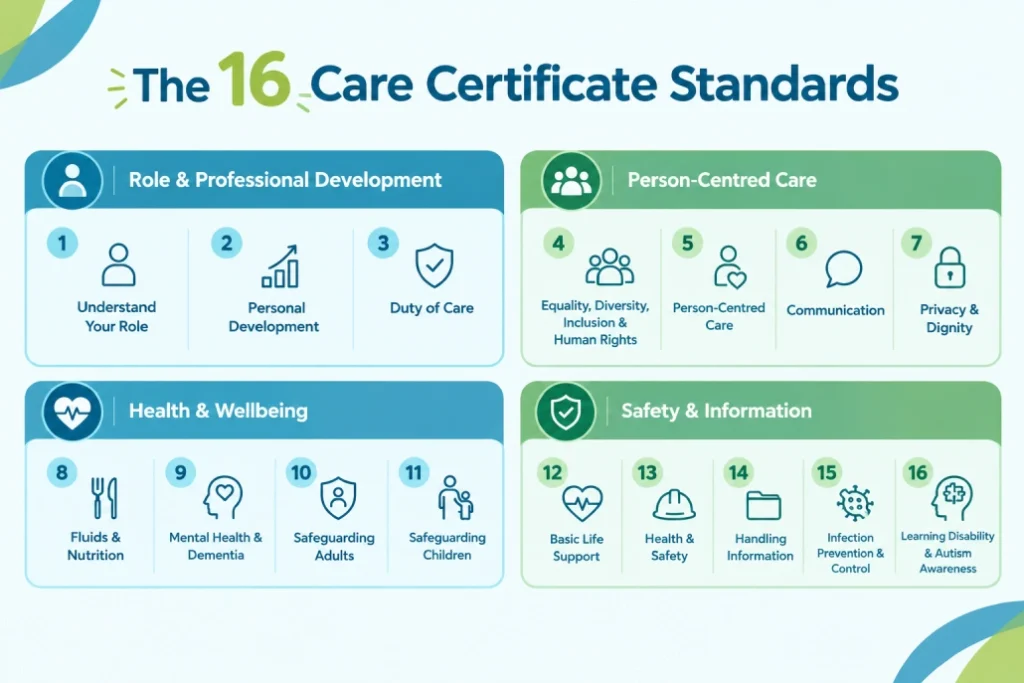
The topics included in the Care Certificate are:
In March 2025, the Care Certificate standards were revised to include a new 16th standard on learning disability and autism awareness. As part of this update, the revised framework reflects the need for care workers to understand and support people with learning disabilities and autism. The revision was developed by Skills for Care and Skills for Health, with input from NHS England and the Department of Health and Social Care.
Is the Care Certificate a Qualification?
No, the Care Certificate itself is an induction framework, not a regulated qualification.
This distinction matters. Completing the Care Certificate can show that you have met the required standards during your induction, but it does not give you a regulated qualification such as a Level 2 or Level 3 diploma.
You can, however, complete additional healthcare qualifications and CPD training to build on the knowledge you gain through the Care Certificate.
How Much Does the Care Certificate Cost?
The Care Certificate does not have a fixed national cost. If you are employed in health or social care, your employer will often provide the training as part of your induction, so you may not need to pay for it yourself.
If you choose to complete Care Certificate training independently, the cost varies between training providers and depends on what the course includes.
Why Does the Care Certificate Matter?
The Care Certificate gives new care workers a clear and consistent starting point. It helps ensure that staff understand the essential skills, knowledge and behaviours needed to provide safe, high-quality care.
It also helps employers monitor training, supervision and competence during a worker’s early stages. This makes it easier to identify learning needs and ensure staff are ready to carry out their roles safely.
Overall, the Care Certificate helps connect staff induction with confident, safe and person-centred practice.
Is the Care Certificate mandatory?
The Care Certificate is not a legal or statutory requirement in England. However, it is widely used as an induction standard for new, unregistered health and social care workers, and some employers may require staff to complete it.
The Care Certificate helps workers develop the knowledge, skills and behaviours needed for safe, person-centred care. Under Regulation 18 of the Health and Social Care Act 2008, registered providers must ensure their staff are suitably qualified, competent and appropriately trained.
Legal Requirement vs Employer Requirement
| Care Certificate status |
What it means |
| Legal requirement |
The Care Certificate itself is not legally mandatory for every healthcare assistant. |
| Regulatory expectations |
Employers must make sure staff have suitable training, support and competence for their roles. |
| Employer policy |
An employer can require new healthcare assistants to complete the Care Certificate. |
| Good practice |
The Care Certificate gives employers a clear framework for induction and assessment. |
Therefore, if your employer includes the Care Certificate in your induction, you will normally need to complete the required standards before they consider your induction complete.
Who Needs the Care Certificate?
The Care Certificate is mainly for workers who are new to health or social care, including healthcare assistants, healthcare support workers, care assistants and support workers. In particular, it helps new staff develop essential skills and understand their responsibilities.
However, if you already have relevant care experience, you may not need to complete every part from the beginning. Instead, your employer can assess your existing knowledge and skills and decide what additional training or assessment you need.
The 16 Care Certificate Standards
The Care Certificate now includes 16 standards, following the March 2025 update. The new 16th standard focuses on learning disability and autism awareness. Instead of treating these standards as a checklist, they work together to build the core skills healthcare assistants need for safe, respectful and person-centred care.
- Understand Your Role – Know your responsibilities, boundaries and place within the care team.
- Your Personal Development – Identify your learning needs, reflect on your work and continue improving.
- Duty of Care – Understand how to protect people and respond appropriately to concerns and difficult situations.
- Equality, Diversity, Inclusion and Human Rights – Respect each person’s rights, choices, identity and differences.
- Work in a Person-Centred Way – Put the individual at the centre of their care while supporting their choices and independence.
- Communication – Build effective communication with patients, families and colleagues by adapting to different needs.
- Privacy and Dignity – Protect personal information, respect boundaries and maintain dignity during care.
- Fluids and Nutrition – Support people with their hydration and nutritional needs safely.
- Awareness of Mental Health and Dementia – Understand how mental health conditions and dementia can affect individuals and their care.
- Safeguarding Adults – Recognise signs of abuse or neglect and know how to report concerns.
- Safeguarding Children – Understand your responsibility for protecting children and reporting welfare concerns.
- Basic Life Support – Develop the knowledge and practical skills needed to respond to emergencies.
- Health and Safety – Recognise workplace risks and follow procedures that protect patients, colleagues and yourself.
- Handling Information – Manage, record and share information securely and appropriately.
- Infection Prevention and Control – Follow good infection control practices to help prevent the spread of infection.
- Awareness of Learning Disability and Autism – Understand the needs and experiences of people with learning disabilities and autistic people, and provide respectful, appropriate support.
Why Was the 16th Standard Added?
In March 2025, Skills for Care added a 16th standard on learning disability and autism awareness. It helps care workers better understand and support people with learning disabilities and autistic people.
This also links to the Oliver McGowan Mandatory Training on Learning Disability and Autism, the government’s required training package for health and social care staff. Under Section 181 of the Health and Care Act 2022, staff working in CQC-registered services must complete training at this level, regardless of whether they complete the wider Care Certificate. While Oliver McGowan training is delivered as a separate programme, it directly aligns with Standard 16.
Who Can Assess the Care Certificate?
A competent person with relevant knowledge and experience should assess the Care Certificate. Usually, the employer appoints someone such as a senior healthcare worker, supervisor or manager to assess workplace competence.
The assessor may review questions, written work, discussions, workplace observations, practical demonstrations and other evidence. Some standards require practical assessment, so an online test alone may not be enough to complete the full Care Certificate.
How Is the Care Certificate Assessed?
The full Care Certificate combines learning with workplace assessment. Learners study the standards, complete knowledge-based activities and demonstrate practical skills where required. A competent assessor then reviews the evidence and signs off each standard when the learner meets the requirements.
How HCA London Assesses Its Care Certificate Course
Healthcare Academy London (HCA London), the Care Certificate Courses are assessed fully online through multiple-choice questions. To pass, learners need to achieve an 80% pass mark. However, unlimited attempts are available, allowing learners to retake the assessment if needed.
Once they successfully complete the course, learners receive a free CPD-accredited Certificate of Completion. This certificate confirms that they have completed HCA London’s online training and studied the Care Certificate standards.
It is important to note that HCA London’s Certificate of Completion confirms completion of its online course. However, completing the full Care Certificate may also require workplace assessment and employer sign-off, depending on the learner’s role and employer requirements.
Care Certificate Assessment Process
Career Progression After the Care Certificate
The Care Certificate can provide a useful starting point for career development. For example, a healthcare assistant may progress through roles such as:
The exact route depends on your employer, experience, qualifications and career goals.
You may also choose to specialise in areas such as:
- Dementia care
- Mental health
- Learning disability support
- Palliative care
- Community care
- Rehabilitation
- Infection prevention
- Patient support
Does the Care Certificate Guarantee Career Progression?
No. The Care Certificate does not automatically lead to a promotion or higher salary. Instead, it gives you a useful foundation. You can then combine it with experience, CPD, additional training and recognised qualifications to develop your career.
Does the Care Certificate Help Healthcare Assistants in the Workplace?
Yes. The standards can help new healthcare assistants understand what safe and effective care looks like in practice.
Example 1: Infection Prevention
Imagine you start working on a healthcare ward. You learn about hand hygiene, PPE and infection prevention. Later, you use these skills when supporting patients and handling care equipment.
The training gives you a clear understanding of why these steps matter.
Example 2: Safeguarding
You notice a change in a patient’s behaviour and become concerned about their wellbeing.
In this situation, your safeguarding training helps you recognise the concern and understand how to respond. As a result, you can follow your employer’s reporting procedure and help protect the patient.
Example 3: Person-Centred Care
A patient has specific preferences about how they receive support. In this case, the person-centred care standard reminds you to listen to the patient and respect their choices. Most importantly, it encourages you to involve them in decisions about their care.
Example 4: Communication
A patient finds it difficult to communicate. Instead of rushing the conversation, you adapt your communication style and give the person enough time to respond.
These examples show why the Care Certificate is more than a list of topics. It helps new healthcare assistants connect knowledge with everyday care.
Care Certificate vs Other Healthcare Training
The Care Certificate and other healthcare training can serve different purposes.
| Feature |
Care Certificate |
Other Healthcare Training |
| Main purpose |
Supports induction for new care workers |
Develops specific knowledge or skills |
| Standards |
16 national standards |
Content varies by course |
| Workplace assessment |
May include workplace evidence and observation |
Depends on the course |
| Who assesses it? |
A suitable competent assessor |
Course provider, employer or awarding body |
| Is it a regulated qualification? |
No |
Leads to regulated qualifications |
| Employer involvement |
Usually significant |
Depends on the programme |
| Career value |
Provides a foundation for care work |
Depends on the qualification or training |
Why Should Healthcare Assistants Complete the Care Certificate?
Even though the Care Certificate is not legally mandatory, completing it can offer several benefits.
1. Build Your Confidence: The standards help you understand what your role involves and how to work safely.
2. Improve Patient Care: You learn important principles such as person-centred care, communication, dignity and safeguarding.
3. Understand Your Responsibilities: The standards help you understand your duty of care and the limits of your role.
4. Meet Employer Expectations: Many employers use the Care Certificate as part of their induction process.
5. Support Your Career Development: Once you understand the basics, you can build on them through CPD, specialist training and further qualifications.
6. Strengthen Workplace Competence: The Care Certificate combines knowledge with practical application, helping you connect training to your everyday work.
How Healthcare Academy London Can Help
Starting a healthcare assistant career is easier when you have the right knowledge. Healthcare Academy (HCA London) offers online healthcare training to help you build skills in areas such as communication, safeguarding, infection control, health and safety and person-centred care.
These courses can support your learning before or alongside your workplace induction. However, your employer must still assess and sign off any Care Certificate standards that require workplace competence.
Ready to strengthen your healthcare skills? Explore Healthcare Academy London’s courses and take the next step in your career.
Conclusion: Is the Care Certificate a Must for Healthcare Assistants?
The Care Certificate is not legally mandatory for every healthcare assistant in England. However, many employers use it during induction and may require new staff to complete it.
More importantly, the Care Certificate gives you a strong foundation for safe and compassionate care. The current framework has 16 standards, covering key areas such as safeguarding, communication, health and safety, infection control, basic life support and learning disability and autism awareness.
So, while you may not need it by law, completing the Care Certificate can be a valuable step towards building your skills, confidence and healthcare career.
Frequently Asked Questions