In this article, you will learn who coordinates safeguarding enquiries, how Section 42 and Section 47 enquiries work, the roles different agencies play, and what happens when someone reports a safeguarding concern.
What Is a Safeguarding Enquiry?
The purpose of a safeguarding enquiry is to investigate concerns of abuse or neglect. Initially, professionals ascertain the facts of the matter. Next, they carry out an assessment of risk. Lastly, they determine what steps need to be taken for protection.
What Is a Safeguarding Concern?
The matter can consist of different kinds of abuse such as physical abuse, emotional abuse, sexual abuse and financial abuse. The matter can also refer to neglect, domestic abuse or organisational abuse. Any person can raise a concern. It can be a relative, carer, teacher, health professional or anybody from the public sector. The matter doesn’t always signify the occurrence of abuse. Nevertheless, the matter should always be treated seriously.
When Does a Concern Become a Safeguarding Enquiry?
Safeguarding concerns can result in an investigation where professionals have to investigate the issue further. They look at the individual’s circumstances and their vulnerability level.
This could be where:
However, not every safeguarding concern leads to a formal enquiry. The safeguarding team reviews the information and chooses the most suitable response.
What Happens When a Safeguarding Concern Is Reported?
Professionals must assess a reported safeguarding concern quickly. The response depends on the person’s situation and the level of risk.
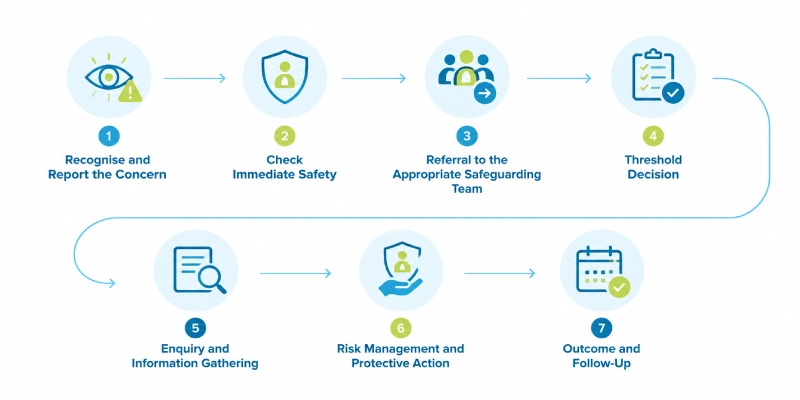
The process may include the following steps:
Step 1: Recognise and Report the Concern
The care worker identifies the signs of any kind of abuse, neglect or risk of harm. They report it to the appropriate safeguarding officer or team within the organisation.
Step 2: Check Immediate Safety
The safety of the individual is the priority. Professionals must sort out all emergencies at once. In case there is an immediate threat to the individual, there will be a need to call for emergency assistance from the relevant agencies.
Step 3: Referral to the Appropriate Safeguarding Team
The team then informs the correct safeguarding service about the concern. In the case of adults, this will often be the Adult Safeguarding Services within the Local Authority. Where children are concerned, this will be Children’s Social Care.
Step 4: Threshold Decision
The safeguarding team assesses the information they have gathered. They consider the risk involved and the circumstances of the individual. They decide on the necessary actions to take. These may include a safeguarding investigation. But not all concerns will reach the necessary threshold.
Step 5: Enquiry and Information Gathering
In case there is a need for the team to enquire, the professionals will gather information regarding the situation. They may interview the at-risk individual. They can also interview relatives, caregivers, and other professionals. The professionals consider the perspective of the individual concerned.
Step 6: Risk Management and Protective Action
The enquiry identifies current risks. Professionals then take proper Action to reduce those risks. The protective step depends on the circumstances, and it could involve a change in care provision or another suitable Action.
Step 7: Outcome and Follow-Up
The enquiry process should result in a clear conclusion. The response should take into account the needs, wishes, and situation of the individual. There may be follow-up that is necessary as well. This allows for an assessment of the effectiveness of any Action taken.
Who Is Responsible for Coordinating Safeguarding Enquiries?
The local authority takes the lead in coordinating safeguarding enquiries. This applies to adult safeguarding across England, and the local authority also carries important statutory duties when child safeguarding concerns come up.
That said, the local authority does not always handle every part of the enquiry itself. It can pass certain tasks to other professionals or organisations. Even then, it stays accountable for making sure the right actions happen.
The Role of the Local Authority
The local authority acts as the main coordinating body. It looks at the safeguarding concern and decides how to respond. Along the way, it works closely with other organisations, including the police and the NHS.
To do this well, the local authority makes sure that:
Some local authorities appoint a dedicated officer to manage an enquiry day to day. That said, exact roles and titles can differ from one local authority to another.
Who Coordinates Adult Safeguarding Enquiries?
For adults in England, Section 42 gives the local authority the legal duty to act. It decides whether a safeguarding enquiry needs to start, and it can carry out that enquiry itself or bring in someone else suited to the task.
Whoever carries out the enquiry needs the right skills and experience, and they should stay independent where independence matters. Throughout the process, the local authority stays responsible for the outcome and for taking the right steps to protect the adult.
Who Leads Child Safeguarding Enquiries?
For children in England, Section 47 places the same kind of duty on the local authority whenever a child faces a risk of significant harm. In practice, a social worker from children’s social care usually leads the enquiry day-to-day.
The local authority does not work alone here. It brings in other bodies too, including the police, health services and education professionals, and each one plays a different part depending on the stage of the enquiry.
If a crime may have taken place, the police carry out their own investigation alongside this. That investigation runs separately from the safeguarding process, though the two often move forward together. Throughout it all, the local authority keeps hold of its statutory duties and its role in coordinating the response.
Adult Safeguarding Enquiries Under Section 42
Section 42 enquiries refer to adult safeguarding enquiries under the Care Act 2014. They take place when professionals suspect abuse or neglect of an adult. The main purpose of an enquiry includes establishing what is taking place and how professionals can prevent future risks to the adult.
What Is a Section 42 Enquiry?
Section 42 enquiries are safeguarding enquiries under the Care Act 2014 in England. They apply when an adult has care and support needs and experiences, or faces a risk of, abuse or neglect. The enquiry helps professionals understand the individual’s concerns and decide what actions they need to take.
What Happens During a Section 42 Enquiry?
The enquiry examines the circumstances and any risks to the adult. This can involve professionals speaking with the adult and other parties. Professionals may also obtain information about care plans. Throughout the process, professionals need to keep the adult’s concerns at the forefront. If professionals identify further risks, they can take immediate steps to protect the adult.
What Happens After a Section 42 Enquiry?
After the Section 42 enquiry, the local authority examines the results and the individual’s needs. This may result in additional support or a safeguarding plan. Another organisation may also take further steps. However, when the adult needs no further safeguarding support, the local authority can close the case.
Who Decides Whether a Section 42 Enquiry Is Needed?
The local authority determines whether it should initiate a Section 42 enquiry. First, it examines the available information and the statutory criteria under the Care Act 2014. It also considers the circumstances of the adult concerned.
Who Can Carry Out a Section 42 Enquiry?
The local authority can undertake the enquiry itself. Alternatively, it may appoint another suitable individual or organisation to carry out the enquiry on its behalf. The local authority must choose a suitably qualified person or organisation to carry out the enquiry.
This could include:
Child Safeguarding Enquiries Under Section 47
Section 47 of the Children Act 1989 sets out the local authority’s duty to make enquiries about a child’s safety. This duty applies when there is reasonable cause to suspect significant harm. The local authority works with other agencies to understand the child’s situation and decide what support or protection they may need.
What Is a Section 47 Enquiry?
A Section 47 enquiry protects children under the Children Act 1989. First, the local authority must have reason to believe that a child may face harm. It then makes enquiries to assess the child’s safety and needs.
When Is a Section 47 Enquiry Started?
A Section 47 enquiry starts when concerns suggest that a child may face significant harm. First, the local authority reviews the available information. It then decides whether the child needs protection.
The most common concerns are:
What Happens During a Section 47 Enquiry?
The local authority collects information about the child and their situation. Professionals may talk to the child, parents or other interested individuals. They can also cooperate with the police, health care and educational services. This procedure examines the child’s safety, welfare, and environment. When necessary, professionals ensure the protection of the child immediately.
What Happens After a Section 47 Enquiry?
Once the enquiry ends, the local authority reviews what it found. It then decides on the next step. Many cases lead to a child protection plan, which sets out how professionals will keep the child safe. Sometimes the family gets extra support instead, with no formal plan needed. If serious concerns remain, the local authority may consider care proceedings through the family court. If the child faces no ongoing risk, the local authority closes the case.
Section 42 vs Section 47: What Is the Difference?
Section 42 and Section 47 both deal with safeguarding enquiries in the UK. Now, let’s look at the differences.
| Section 42 |
Section 47 |
|
Applies to adults with care and support needs.
|
Applies to children.
|
|
Comes under the Care Act 2014.
|
Comes under the Children Act 1989.
|
|
Concerns abuse or neglect.
|
Concerns suspected significant harm.
|
|
The threshold rests on abuse, neglect, or risk of either.
|
The threshold rests on suspected significant harm.
|
|
The local authority carries out or arranges the enquiry.
|
The local authority makes enquiries through children’s social care.
|
|
Outcomes may include support, a safeguarding plan, or case closure.
|
Outcomes may include a child protection plan, extra support, care proceedings, or case closure.
|
What Roles Do Other Agencies Play in Safeguarding Enquiries?
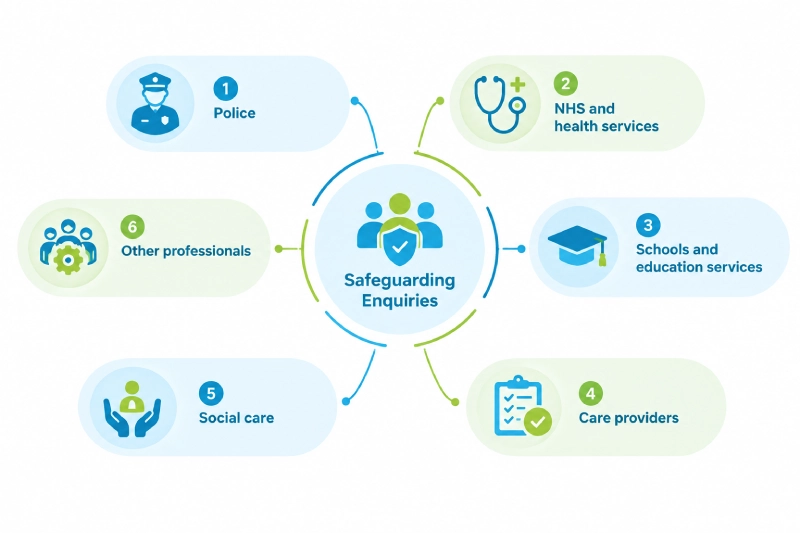
Safeguarding often involves several agencies. Each one plays a different role depending on the concern and the person’s needs.
| Agency |
Main Role |
|
Police
|
Investigate suspected crimes and help protect people from immediate danger.
|
|
NHS and health services
|
Provide medical care and share relevant health information.
|
|
Care providers
|
Report concerns, protect people in their care and provide information.
|
|
Schools and education services
|
Highlight problems relating to children and provide relevant information.
|
|
Social care
|
Assess risks, coordinate safeguarding efforts and provide protection.
|
|
Other professionals
|
Share relevant knowledge and provide specialist advice when needed.
|
What Happens When Multiple Agencies Are Involved?
Many safeguarding cases involve more than one agency. When this happens, agencies need to work together:
Coordinating vs Investigating a Safeguarding Enquiry
The local authority usually coordinates the safeguarding response. It organises the process and brings in the right professionals. Investigating works differently, since different professionals handle it based on the concern. The police investigate suspected crimes, while a social worker gathers information for the enquiry. These two processes often run at the same time, and good coordination helps professionals respond to the person’s needs while the investigation continues.
What Should You Do If You Have a Safeguarding Concern?
If you suspect abuse, neglect or any other form of harm, report it through the correct safeguarding procedures. You do not need proof before raising a concern.
If someone faces immediate danger, contact the emergency services straight away.
When you make a report, keep these points in mind:
Real-World Safeguarding Examples
Safeguarding concerns can arise in many different situations. Here are some simple examples:
A care worker notices that an older adult often misses meals and personal care. They report the concern for assessment.
Someone is using an adult’s money without permission. Professionals report the concern and review the situation.
A teacher notices that a child often arrives at school hungry and poorly cared for. The teacher reports the concern to children’s social care.
A professional notices unexplained injuries on a child or adult. Professionals report the concern and involve the appropriate agencies when needed.
A professional becomes concerned that someone is experiencing domestic abuse at home. They follow safeguarding procedures and assess the support the person needs.
Common Misconceptions About Safeguarding Enquiries
Many people misunderstand safeguarding enquiries. Here are some common myths and the facts behind them.
| Myth |
Fact |
|
You need proof before reporting a safeguarding concern.
|
You can report a concern based on reasonable worries or observations.
|
|
Only social workers can report concerns.
|
Anyone can raise a safeguarding concern.
|
|
Every concern leads to a formal enquiry.
|
The response depends on the circumstances and level of risk.
|
|
The police handle every safeguarding query.
|
The police may investigate crimes, while the local authority manages safeguarding duties.
|
|
Safeguarding is only about finding out what happened.
|
It also considers risks, wishes and the support or protection needed.
|
Why Safeguarding Training Matters for Care Workers
Safeguarding training helps care workers recognise signs of abuse, neglect and harm early. It also teaches them how to report concerns correctly, respond to risks appropriately, and protect people’s dignity, safety and wellbeing. Regular training keeps care workers confident and up to date with current safeguarding guidance.
Healthcare Academy (HCA London) offers safeguarding training designed to build this exact knowledge and confidence. Our courses cover key safeguarding principles and help you respond to different concerns with the right Action. Strengthen your skills, meet your professional responsibilities, and support the safety and wellbeing of those in your care.
Final Thoughts
Safeguarding enquiries help protect adults and children from abuse, neglect and harm. In England, the local authority has the main statutory responsibility for coordinating these enquiries. Other agencies also play an important role.
Understanding who leads safeguarding enquiries in the UK, and how the process works, helps care workers respond to concerns with greater confidence. Most importantly, safeguarding should always focus on the person’s safety, wellbeing and needs.
Frequently Asked Questions