Picture this. You work in a care home kitchen, and the lunch rush has just ended. Suddenly, an environmental health officer walks in and asks, “Can I see your HACCP records?” Your mind goes blank. So, what does HACCP actually stand for, and what does it mean?
HACCP stands for Hazard AnalysisandCritical Control Points. It means a food safety system that finds the points where food could become unsafe, then controls each one before it harms anyone. In simple terms, it helps you prevent problems instead of fixing them after they happen.
In this guide, you will learn what each word means, whether UK law requires HACCP, and who needs a plan. You will also see how the seven principles work, follow a real care kitchen example, and find out how to build and review your own plan.
What Does HACCP Stand For?
HACCP stands for Hazard Analysis and Critical Control Points. That sounds like a mouthful, so let’s break it down one word at a time. The table below shows what each letter stands for and what it means in plain English.
H
Hazard
Anything in food that could make someone ill, such as germs, chemicals, or a piece of glass.
A
Analysis
A close look at each step in your kitchen to find where hazards could appear.
C
Critical
Very important, because food becomes unsafe if this step goes wrong.
C
Control
An action that stops a hazard or brings it down to a safe level.
P
Points
The exact steps in your process where you take that action.
Now, let’s put the words together. HACCP means finding the hazards in your food, then controlling them at the steps that matter most. For example, a fridge that runs too warm lets germs grow fast. So, checking the fridge temperature is a control point. Keep this meaning in mind, because the next section on the law builds on it.
How Do You Pronounce HACCP?
Most people say HACCP as “HAS up”. The first part rhymes with “mass”. So, you do not need to spell out each letter. Just say it as one short word.
Is HACCP a Legal Requirement in the UK?
Yes, HACCP is a legal requirement in the UK. Every food business must have a documented food safety system based on HACCP principles. That includes restaurants, takeaways, and care homes. However, businesses in primary production, transport, and storage sit outside this rule.
What Does the Law Say?
The rule comes from Article 5 of Regulation (EC) 852/2004. It tells food businesses to put in place, carry out, and maintain permanent procedures based on HACCP principles.
What Changed After Brexit?
Not much for HACCP. Great Britain kept the regulation as retained EU law, which the UK now calls assimilated law. The UK also made small changes so the regulation works for England, Wales, and Scotland, such as naming the Food Standards Agency (FSA) and Food Standards Scotland (FSS) as regulators. Meanwhile, the EU Version of the regulation applies in Northern Ireland.
Each nation also has its own hygiene regulations. The table below shows them.
No. The law lets businesses match their procedures to their size and type, so many small businesses can use simple records. For example, the FSA created Safer Food, Better Business for small and medium businesses such as cafes, restaurants, pubs, takeaways, and nurseries. In Scotland, most caterers use a system called CookSafe. The FSA also offers guidance on a flexible approach for low-risk food businesses.
Still, simple does not mean optional. Larger or more complex businesses, such as manufacturers, may need a full HACCP plan. So, the size of your plan depends on your risks.
Who Enforces HACCP?
Local council environmental health officers enforce it. During an inspection, they review your food safety management system. If they find problems, they have several options.
They can serve a hygiene improvement notice that gives you at least 14 days to fix the problem.
If you ignore that notice, you commit an offence.
In serious cases, they can close the business with an emergency prohibition notice. Breaking that notice can lead to a fine or up to two years in prison.
In short, HACCP is not optional, but it is flexible. Next, let’s look at who needs a HACCP plan.
Who Needs a HACCP Plan?
Almost every food business needs one. The law defines a food business as any undertaking that handles food, whether it makes a profit or not and whether it is public or private. So, if your business prepares, serves, or sells food, HACCP applies to you.
Which Businesses Must Follow HACCP?
The list is long. Schools, hospitals, and care homes that serve food all count. Restaurants, takeaways, caterers, retailers, and manufacturers count too. However, the size of your plan depends on how complex your food and processes are.
Can You Use a Simplified Approach?
Often, yes. The law does not demand complex HACCP in every business. Instead, your documents and records must match the size and type of your business.
For small and medium businesses, the FSA created Safer Food, Better Business (SFBB). It suits smaller businesses that find a full HACCP system harder to set up, and it focuses on cooking, cleaning, chilling, and cross-contamination. There is also a residential care supplement for care settings.
Still, a simple system does not fit everyone. Here are the main limits.
Manufacturers usually do better with a full HACCP plan.
Butchers, fishmongers, and bakers should speak to their local environmental health team first.
SFBB alone does not cover sous vide cooking. The same goes for vacuum packing, and the FSA’s MyHACCP tool can help you build a full plan instead.
Who Does What?
HACCP works best as a team effort. The law places clear duties on the food business operator. Here is how those duties land on each role.
Owners and operators. They carry the legal duty to meet food law in their business. They must also make sure staff get supervision and training.
Managers and HACCP leads. Anyone who builds and runs the system needs adequate training in HACCP principles. They also keep the records up to date.
Food handlers. Anyone who handles food, packaged or unwrapped, needs supervision, instruction, or training that matches their job. Then they follow the plan every day.
Which Setup Fits Your Business?
The table below sums up what each type of business usually needs.
Business type
What it usually needs
Cafes and takeaways
The SFBB caterers pack with daily checks
Care homes
The SFBB pack with the care supplement
Nurseries and schools
A simple system that fits the kitchen
Hospital kitchens
A system that fits the size and risks
Food retailers
The SFBB retail pack for shop food
Food manufacturers
A full HACCP plan with detailed records
Butchers and bakers
An adapted plan based on local advice
Sous vide users
A full plan with additional controls
What Is HACCP?
You already know what the letters mean, so here is the short Version. HACCP is a food safety system built on prevention. It spots hazards early and stops them before they reach anyone’s plate.
Where Did HACCP Come From?
HACCP began in the early 1960s. The Pillsbury Company worked with NASA and the US Army Natick Laboratories to make food that was safe for astronauts. The old methods did not work for space food, because NASA would have needed to test almost every product and would have had little left to eat. So, the team built a system that prevents problems instead of finding them afterwards. In 1971, the idea reached the public at the US National Conference on Food Protection.
How Did HACCP Become a Global Standard?
At first, HACCP had only three principles, but it later grew to seven. Then, in 1993, the Codex Alimentarius Commission adopted guidelines for applying it. Codex is the joint food standards body of the FAO and WHO. Because Codex recommends HACCP, it has become the international reference system for food safety.
Today, the same seven principles guide food businesses around the world. They run from hazard analysis all the way to record-keeping. We will explain each one later in this guide.
Why HACCP Matters
HACCP matters because food poisoning is common and costly. In the UK, an estimated 2.4 million people get a foodborne illness each year, and the cost to the country reaches about £9 billion.
The risk is higher for some people. Babies, young children, older adults, pregnant women, and people with weakened immune systems can become seriously ill much more easily. Care homes, hospitals, nurseries, and schools look after these groups every day, so a strong food safety system matters even more there.
The table below shows what HACCP gives you in practice.
✓The benefits of HACCP
6 practical benefits
Benefit
What it means in practice
01Fewer illnesses
You identify and control hazards before food reaches anyone.
02Safer care
Residents and patients face a lower risk of foodborne illness, which can be particularly serious for vulnerable people.
03Legal compliance
You follow food safety requirements and keep records that help demonstrate due diligence.
04Less food waste
You spot storage, temperature or handling problems early, helping prevent avoidable food waste.
05Better inspection outcomes
Accurate records and consistent procedures help demonstrate that your food safety controls are being followed.
06Greater trust
Customers can check published food hygiene ratings, while reliable food safety practices help build confidence in your business.
The legal row works in real life too. If a business ends up in court, a documented system can show that it took steps to prevent an offence.
The last two rows deserve a closer look. Officers score how well you manage and record food safety, and the rating goes public on the FSA website. Without a fully documented system, you may only reach a rating of 1 out of 5. So, good records protect your reputation as well as your customers.
Next, let’s look at the hazards that HACCP controls.
What Are the Types of Food Hazards?
A hazard is anything that can make food unsafe. HACCP sorts hazards into four main types, which are biological, chemical, physical, and allergenic. Some guides list only three, but most treat allergens as a fourth type because they need their own controls.
The table below shows each type, with examples, common sources, and how HACCP controls it.
4The four main food hazards
HACCP essentials
HAZARD 01
Biological
Harmful microorganisms
Examples
Salmonella, E. coli and norovirus
Common sources
Raw meat, eggs and unwashed hands
HACCP controls
Cooking, chilling and handwashing checks
HAZARD 02
Chemical
Harmful chemical substances
Examples
Cleaning agents and heavy metals
Common sources
Poor storage and mixed-up bottles
HACCP controls
Safe storage and supplier checks
HAZARD 03
Physical
Foreign objects in food
Examples
Glass, metal, plastic and pests
Common sources
Broken equipment and loose packaging
HACCP controls
Inspection, detection and pest control
HAZARD 04
Allergenic
Food allergens and cross-contact
Examples
Milk, eggs, nuts and gluten
Common sources
Shared tools and mislabelled food
HACCP controls
Separate preparation and clear labels
Biological hazards cause most of the illness you hear about. In the UK, norovirus has the biggest known burden, and Campylobacter comes next. So, temperature control and hygiene sit at the heart of most HACCP plans.
Allergens need extra care. UK law names 14 major allergens, and you must tell customers if any of them appear in your food. They are cereals containing gluten, crustaceans, molluscs, eggs, fish, peanuts, nuts, soya, milk, celery, mustard, sesame, lupin, and sulphur dioxide. Staff also need allergen training, because one shared spoon can cause a serious reaction.
Prerequisites and Preventive Measures
A HACCP plan cannot work on its own. It needs basic hygiene habits in place first. These habits are called prerequisite programmes, or PRPs for short. Think of them as the foundation of a house. If the foundation is weak, even the best plan will struggle to control risks.
So, what should you have in place? Here are the main measures.
Personal hygiene:
Clean hands and clothes stop germs from reaching your food.
Cleaning and disinfection:
Clean surfaces and tools stop germs from spreading further.
Pest control:
Pests carry germs and can contaminate your food directly.
Temperature control:
Cold and hot storage stop germs from growing fast.
Safe suppliers and traceability:
You can find the source quickly when problems appear.
Staff training:
Trained staff follow the safety rules every single day.
Waste handling:
Covered bins and regular removal stop waste from spreading germs.
Allergen control:
Careful handling keeps allergens out of the wrong meals.
Traceability deserves a quick explanation. The law asks you to know who supplies your food and which businesses you supply. People call this one step back, one step forward. However, you do not need to track customers when you sell directly to the final consumer. In a care kitchen, that usually means keeping supplier details and delivery notes in one safe place.
Once these basics work well, your HACCP plan can focus on the steps that matter most. Now, let’s look at the seven principles that make up a HACCP system.
The Seven HACCP Principles Explained
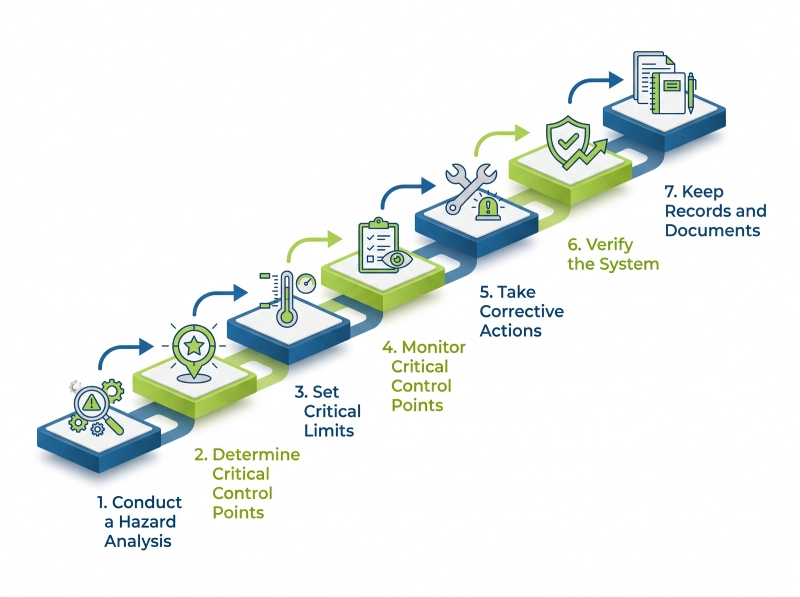
The seven principles are the heart of HACCP. They work like steps on a ladder, so each one builds on the one before. The Codex Alimentarius Commission published them, and UK law refers to them in Article 5 of Regulation 852/2004.
Here is the quick view.
Conduct a hazard analysis to find what could go wrong.
Determine the critical control points where you can stop hazards.
Set critical limits that show a point stays under control.
Monitor each critical control point to check that the limits are held.
Take corrective Action straight away when a limit is missed.
Verify that the whole system works the way you planned.
Keep clear records and documents that prove your system works.
Now, let’s look at each one in plain English. The examples follow a care home kitchen that makes cottage pie.
Principle 1. Conduct a Hazard Analysis
First, walk through every step in your kitchen, from delivery to serving. At each step, ask what could go wrong. Then list the hazards and decide which ones are serious enough to control.
Care kitchen example. The team lists every step for the cottage pie, from the mince delivery to the dinner trolley. They notice that undercooked mince and slow cooling both put residents at risk.
Principle 2. Determine the Critical Control Points
A critical control point, or CCP, is a step where you can stop a hazard or bring it down to a safe level. After that step, nothing else can fix the problem. However, not every step is a CCP. Most steps rely on your normal hygiene habits instead.
Care kitchen example. Cooking the mince is a CCP because it is the last step that kills germs. Handwashing is a vital habit, but it is not a CCP.
Principle 3. Set Critical Limits
A critical limit is a clear line between safe and unsafe. You must be able to measure it, so most limits use time or temperature. If food stays inside the limit, it is safe. If it falls outside, you must act.
Care kitchen example. The kitchen sets a core temperature of 70°C for two minutes for the mince. An equivalent option is 75°C for 30 seconds. If the team holds the pie hot before serving, the limit is 63°C or above.
Principle 4. Monitor the Critical Control Points
Monitoring means checking that each CCP stays inside its limit. Decide who checks, how they check, and how often. Then make sure the check happens every time, because a limit only works when someone watches it.
Care kitchen example. The cook probes the centre of every batch of cottage pie with a clean thermometer. Then the cook writes the reading in the temperature log.
Principle 5. Take Corrective Actions
Sometimes a check will fail. Corrective Action is your plan for that moment. First, make the food safe or remove it. Next, find out why the limit slipped. Finally, fix the cause so it does not happen again.
Care kitchen example. One tray of mince reads only 65°C. The cook keeps cooking and probes it again. If the tray sat too long in the danger zone, the cook throws it away and notes why.
Principle 6. Verify That the System Works
Monitoring checks the food. Verification checks the system. It proves that your plan works in real life and not only on paper. A manager can review the logs, watch staff at work, and test equipment such as thermometers.
Care kitchen example. Each week, the manager reads the temperature logs and watches a cook probe a batch. The manager also tests the thermometer to confirm it reads correctly.
Principle 7. Keep Records and Documents
Records are your proof. If it is not written down, an officer cannot see that you did it. Keep your records simple, honest, and easy to find, because officers expect to see them at inspection. Most kitchens keep these logs.
Temperature logs. Cooking, chilling, hot holding, and fridge readings.
Cleaning records. Who cleaned what, and when they finished.
Corrective Action records. What went wrong, and what the team did.
Training and supplier records. Who learned what, and who supplies you.
Care kitchen example. The kitchen keeps the cottage pie temperature logs, fridge checks, and cleaning sheets together. Staff sign each entry the same day.
Key Terms at a Glance
Hazard. Anything in food that can cause harm.
Critical control point. A step where you can stop a hazard.
Critical limit. A measurable line between safe and unsafe.
Corrective Action. What you do when a limit is missed.
Verification. Checks that prove the whole system works.
Now, let’s see all seven principles work together in one dish.
HACCP Example in a Care Home Kitchen
Let’s put all seven principles to work on one dish. Picture a care home kitchen that cooks chicken for residents’ lunch. Many residents are older people, so the stakes are high. Here is how the team applies each principle.
Hazard analysis. The team spots germs in raw chicken, cross-contamination from boards and hands, and slow cooling.
Critical control points. They choose cooking, cooling, and hot holding as the steps that control the risk.
Critical limits. Each CCP gets a clear measure, such as 70°C for two minutes.
Monitoring. A named cook probes the chicken and writes down the reading every time.
Corrective Action. If a limit fails, the cook fixes the food and then finds the cause.
Verification. The manager reviews the logs and tests the thermometers each week.
Records. Staff sign every log on the same day, and the manager files them safely.
The cards below pulls the Action plan together.
01
Cooking
Critical control point
Critical limit
70°C for two minutes
Hazard
Germs in raw chicken
Monitoring
Probe every batch
Corrective action
Cook longer, then probe
Records
Cooking temperature log
02
Cooling
Critical control point
Critical limit
Below 8°C in 90 minutes
Hazard
Germs growing while cooling
Monitoring
Time and probe checks
Corrective action
Discard slow-cooled food
Records
Cooling time log
03
Hot holding
Critical control point
Critical limit
63°C or above throughout
Hazard
Germs grow in warm food
Monitoring
Probe at set times
Corrective action
Reheat or discard food
Records
Hot holding log
These limits follow UK council guidance on cooking, cooling, and hot holding.
Notice what the table leaves out. Handwashing, cleaning, and keeping raw chicken away from cooked food belong to your prerequisites, so they are not CCPs. That split keeps your plan short and focused.
What Is a HACCP Plan and How Do You Create One?
A HACCP plan is a written document that shows how your business controls food safety hazards. It brings the seven principles together for your own food, in your own kitchen. Because every kitchen is different, a plan is specific to a particular food and process. So, you cannot simply copy another business’s plan.
How to Make a HACCP Plan in Six Steps
Build your team.
Gather people who know the food and the kitchen, such as the head cook, the manager, and a care lead. A strong team matters, because the system will not succeed without one.
Describe the food and who eats it.
Write down what the dish is, how you make it, and how long it keeps. Then note who will eat it in a care home, including older residents who face a higher risk.
Draw a flow diagram.
List every step in order, from delivery to serving. Include each ingredient, because hazards can enter at any point.
Confirm the diagram on site.
Walk through your kitchen and check that the diagram matches real life. Do this at different times of the day, and update the diagram when something changes.
Apply the seven principles.
Work through the hazard analysis, CCPs, limits, monitoring, corrective actions, verification, and records, just as in our cooked chicken example.
Set up your record sheets.
Create simple templates for the logs listed under Principle 7. Then make sure every member of staff knows where to find them.
Free Help From the FSA
The FSA offers a free online service called MyHACCP. It guides you through each stage of making or updating a HACCP plan, and it lets you save your progress and come back later. It also produces a downloadable plan, with monitoring record sheets to help you get started.
Before you start, have these ready.
Details of the food you make or handle
A list of ingredients, raw materials, and processes
Temperature records and cleaning schedules, if you have them
Information about your suppliers and staff training
However, MyHACCP mainly suits small food manufacturers. If your kitchen has simple processes, such as a cafe or sandwich bar, the FSA says Safer Food, Better Business or the Safe Catering pack may fit better.
Next, let’s compare HACCP with food hygiene training and ISO 22000, since many people mix them up.
HACCP, Food Hygiene Training, and ISO 22000 Compared
People often mix these three up, but they do different jobs. HACCP is a food safety system. Food hygiene training is how your staff learn to work safely. ISO 22000 is an optional international standard that an outside auditor can certify.
The table below compares them side by side.
Question
HACCP
Food hygiene training
ISO 22000
What is it?
A system that prevents food safety problems
Learning that teaches staff safe habits
A global standard for food safety systems
Who needs it?
Every food business, large or small
Staff, with training suited to their roles
Businesses that choose to seek certification
What does it show?
Your kitchen manages its food safety risks
Staff understand how to handle food safely
The food safety management system has been independently audited for certification
Is it a legal duty?
Food businesses must have food safety procedures based on HACCP principles
Food handlers must receive appropriate supervision and training; a specific certificate is not always legally required
Certification is generally voluntary, although customers or contracts may require it
ISO 22000 deserves a closer look. It takes the HACCP principles and adds management rules, such as clear leadership, communication along the food chain, and regular improvement. So, it covers more ground than a standard HACCP plan. Even so, certification is not mandatory.
Which One Does a Care Setting Need First?
Start with a working HACCP-based system, because the law requires it. Next, make sure your staff get the right training for their jobs. We cover certificates and levels later in this guide. Finally, think about ISO 22000 only if a client, contract, or head office asks for it.
When and How Should You Review a HACCP System?
A HACCP system is not a document you write once and File away. Your kitchen changes over time, so your plan must change with it.
What Should Trigger a Review?
The law is clear on this. Whenever you change a product, a process, or any step, you must review your procedure and update it. Here are the most common triggers.
A new dish or ingredient that changes your process
New equipment, a new supplier, or a new delivery method
A change to your kitchen layout or cleaning chemicals
A customer complaint or a food safety incident
A failed check or a missed critical limit
Feedback or advice from an inspector after a visit
How Often Should You Review?
Besides these triggers, you need regular scheduled reviews. UK guidance differs on how often, but councils agree on one point. Review the whole system at least once a year.
Some systems build the habit in for you. The FSA’s Safer Food, Better Business diary includes a 4-weekly review, and you must complete it even when you find no problems. Meanwhile, Scotland’s CookSafe system suggests a review ideally every six months.
How to Review Your System
Check your records. Walk around the kitchen, watch the team work, and read your recent logs.
Repeat the hazard analysis. Ask whether any new hazard has appeared since your last review.
Update the plan. Change any limits, checks, or actions that no longer fit, then sign and date the change.
Retrain your staff. Tell everyone what changed, so the new method sticks. In Scotland, guidance says staff need training at every review.
How Long Should You Keep Records?
There is no legal minimum, so you decide what is sensible for your business. Think about the shelf life of your food and how people might use it later. For example, some councils suggest keeping daily logs for around three months.
Reviews keep your system alive. Next, let’s look at HACCP certificates, training levels, and expiry.
HACCP Certificate, Training, and Expiry
Do You Need a HACCP Certificate?
No. UK law does not name a specific HACCP certificate, course, or level. However, the law does require adequate training. The people who build and run your HACCP procedures need training in HACCP principles, and every food handler needs supervision, instruction, or training that matches their job. So, a certificate is not a legal duty, but it is the easiest way to prove that your training happened.
Training Certificate or Business Certification?
These two get mixed up often, so here is the difference.
Training certificate. It shows that one person finished a course and passed the test.
Business certification. It shows that an auditor approved your whole food safety system, such as ISO 22000. This is voluntary.
Which Level Suits Which Role?
Industry guides give a clear starting point for most kitchens.
Food handlers. Level 2 suits anyone who prepares or handles high-risk open food.
Supervisors and managers. Level 3 is good practice for those who also lead others.
HACCP leads. Anyone who builds the plan needs adequate HACCP training for the role.
Do Certificates Expire?
There is no legal expiry date, because no rule sets a retraining period. Even so, many training providers suggest renewing a Level 2 certificate every three years. Your employer or local authority may also set its own refresher period. So, check what your workplace expects.
Training keeps your plan alive, but the plan can still fail. Next, let’s look at why HACCP systems fail and how to fix each cause.
If your team needs food safety training, Healthcare Academy(HCA London) offers Food Hygiene and Food Safety and Hygiene course. It helps staff understand essential food safety practices, maintain proper hygiene standards, and reduce the risk of food contamination. Investing in appropriate training can also help your organisation meet food safety requirements and promote a safer environment for everyone.
Why Do HACCP Systems Fail?
Most HACCP failures are not about science. They come from simple habits that slip over time. Officers pay close attention to this, because complete, accurate, and well-used paperwork has a big effect on your hygiene rating. Here are the six most common causes, with a fix for each.
Poor or missing records.
Officers cannot see what you did, so gaps look like failures. Fix this with simple logs that staff complete and sign every day.
Weak staff training.
Staff who do not understand the plan will skip checks. Fix this with induction training and a short refresher whenever the plan changes.
Unclear CCPs or unrealistic limits.
Staff ignore vague steps and impossible targets in a busy kitchen. Fix this with clear, measurable limits that your team can really meet.
Templates that nobody adapted.
A copied plan does not match your menu or your kitchen. Fix this with edits so every template describes what you actually do.
Checks that exist only on paper.
Monitoring and corrective actions fall apart when nobody follows them in practice. Fix this with real observation and regular chats with your team.
No review after changes.
New dishes and equipment make an old plan wrong. Fix this with a review after every change, and at least once a year.
Final Thoughts
HACCP (Hazard Analysis and Critical Control Points) helps food businesses keep food safe and meet UK food safety requirements. Keep your system simple by focusing on good hygiene, cleaning, temperature control, and accurate records. Review your plan regularly and train your staff to follow safe practices every day. In care settings, good food safety is especially important because residents may be more vulnerable to foodborne illness.
The four Cs are Cleaning, Cooking, Chilling, and Cross-contamination prevention. They help food businesses keep food safe and protect customers from foodborne illness.
Keep your fridge at 5°C or below. Store raw meat and fish in sealed containers on the bottom shelf, and keep ready-to-eat foods on higher shelves to prevent contamination.
A use-by date relates to food safety, so do not eat food after this date. A best-before date relates to quality, meaning the food may still be safe afterwards if stored correctly and suitable to eat.
Do not serve the food until you have checked whether it is safe. Follow your food safety procedures, record the problem, and take corrective Action based on the food’s temperature and how long it has been unsafe.
Cross-contamination happens when harmful bacteria or allergens spread from one food, surface, or utensil to another. Use separate equipment for raw and ready-to-eat foods, and clean hands and surfaces properly.
Food businesses should clearly identify allergens in their ingredients, prevent allergen cross-contact, and provide accurate information to customers. Staff should understand allergen procedures and never guess whether a food is safe for someone with an allergy.