Healthcare assistants can administer medication, but only within clearly defined professional boundaries. The role requires appropriate training, proven competence, and authorisation from your employer. However, you must also follow your organisation’s medication policies and only carry out tasks that fall within your scope of practice and duties. Understanding these requirements is essential for protecting patient safety and carrying out your responsibilities with confidence.
Without clarity, you either overstep or fall short, and both carry consequences. So let’s clearly understand safe medication administration guidelines UK in this article.
The Legal Framework in the UK
In the UK, the Medicines Act 1968 governs medication. In simple terms, you need authorisation to handle, give, or manage it. Nobody gets a free pass. If you’re learning how to administer medication as a carer, it’s important to understand that you do not have an automatic legal right to administer medication. A registered healthcare professional, such as a nurse or GP, must delegate the task to you, and your employer must authorise you after you have received the appropriate training. The Care Quality Commission (CQC) actively monitors how care settings manage medication to ensure legal and regulatory standards.
What Healthcare Assistants Can Do
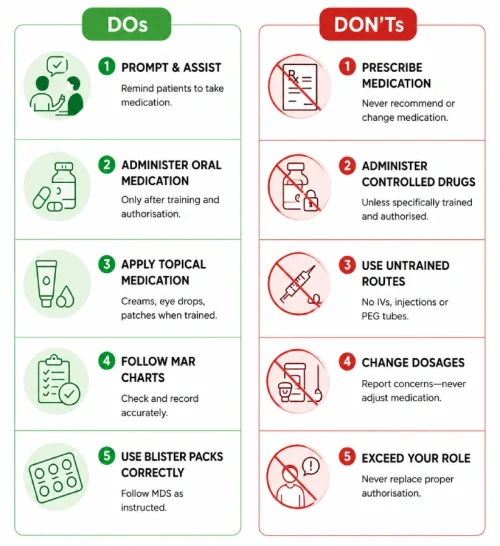
More than you might think, as long as you’ve got the right training and authorisation behind you. You expand your scope every time you build on your competency. So let’s break down exactly what the 5 steps for medication administration are:
1. Prompting and Assisting:
If a service user manages their own medication, your job might simply be to remind them it’s time and stay with them while they take it. That’s prompting, and it’s not the same as administering. You’re not handling the medication or making any decisions about it.
2. Administering Oral Medication:
Tablets, capsules, liquids- yes, this is something healthcare assistants can do. But your employer needs to have formally trained you, assessed your competency, and signed you off.
3. Topical Applications:
Creams, ointments, eye drops, patches, medicated dressings; these all fall under medication administration, too, which surprises some people. With the right training, applying these is absolutely within your scope.
4. Using MAR Charts:
A Medication Administration Record chart, or MAR chart, is one of the most important documents you’ll work with. It tells you what medication a person is on, when it’s due, what dose, and by which route. Record everything on the chart, including missed doses, refusals, and late administrations.
5. Blister Packs and MDS Systems:
Monitored Dosage Systems, commonly known as blister packs or MDS, are widely used in residential and domiciliary care settings. A pharmacist pre-packs them, organises them by day and time, and makes the administration process more straightforward.
What Healthcare Assistants Cannot Do?
Knowing what you can do builds your confidence but knowing what can you not do when administering medication? That’s what keeps your patients safe and your practice protected.
1. Prescribing Medication:
This one’s non-negotiable. No matter how long you’ve been in the job or how many times you’ve seen a particular medication given, recommending it, suggesting a change, or deciding someone needs something different is never your call.
2. Administration of Controlled Drugs:
Before we get into that, what are high-risk medications exactly? Remember, controlled drugs, such as morphine, strong painkillers, and certain sedatives, come with a whole separate set of rules. And for good reason. You can’t just administer these because someone asked you to or because it seemed fine last time.
3. Administration via Untrained Routes:
IV lines, PEG tubes, injections- these aren’t something you pick up on the job by watching. They need proper training and a formal sign-off. Your training and assessment determine your boundaries. Stay within them.
4. Clinical Judgements on Dosage:
You might notice that something doesn’t seem right, a dose looks too high, or a service user says it’s not working. At that moment, your instinct matters. But what you do with it matters more. Flag it, report it, escalate it. Don’t adjust it yourself.
5. Professional Boundaries:
A chaotic shift, a short-staffed morning, a senior colleague saying “just this once”- none of it is a good enough reason to go beyond what you’re trained and authorised to do. Pressure is not the same as permission.
The Role of Delegation
Delegation is a formal process, not a casual handover, and for good reason. An estimated 237 million medication errors occur in England every year, making clear communication and accountability essential. When a registered nurse delegates a medication task to you, they remain accountable for the decision to delegate, while you are also responsible for carrying out the task safely. Consequently, proper delegation requires a registered healthcare professional to assess your competence and provide clear instructions.
The 7 Rights of Safe Medication
Knowing how to avoid medication errors starts with following the 7 Rights of Medication Administration every single time. So, let’s understand it in a simple way:
| The 7 Rights |
What It Means |
| Right Patient |
Confirm the patient’s name and date of birth against the MAR chart before administering medication. |
| Right Medication |
Check the medicine label carefully against the prescription or MAR chart. |
| Right Dose |
Verify that the patient receives the correct dose as prescribed. |
| Right Route |
Ensure the medication is taken by the correct route, such as swallowing, inhaling, or applying it to the skin. |
| Right Time |
Administer the medication at the scheduled time. |
| Right Reason |
Confirm why the patient is taking the medication and ensure it matches the care plan. |
| Right Documentation |
Sign and complete the MAR chart immediately after administering the medication. |
What Happens When Things Go Wrong
Nobody wants to make a mistake. But in medication administration, errors do happen, but how you respond matters as much as what went wrong. If you give the wrong medication, the wrong dose, or even miss a dose entirely, then report it immediately. Don’t wait, don’t hope it sorts itself out, and definitely don’t cover it up.
Ready to Get Properly Qualified?
If you want to feel genuinely confident around medication, not just getting by, but actually knowing what you’re doing, Healthcare Academy (HCA London)‘s Medication Administration and Management course is worth a serious look.
This course is for healthcare assistants and support workers. Fortunately, you’ll cover everything from the ethical matters to safe storage, and what to do when things don’t go to plan. Practical, relevant, and built around the realities of safe handling of medications in health and social care. Because in this job, confidence without competence is dangerous. But competence? That’s what keeps your patients safe and your practice solid.
FAQS
1. Can healthcare assistants administer medication?
Employers authorise healthcare assistants to administer medication after they complete training, pass a competency assessment, and work within their scope of practice.
2. What qualifications do healthcare assistants need to administer medication?
Healthcare assistants need medication administration training, a competency assessment, and employer authorisation before administering medicines.
3. Can healthcare assistants administer controlled drugs?
Healthcare assistants can administer controlled drugs only if permitted by their employer’s policy, appropriately trained, and authorised to do so.
4. What is a MAR chart?
A Medication Administration Record (MAR) chart records the medicines prescribed, when they should be given, and when they have been administered.
5. What should you do if a patient refuses medication?
Record the refusal, inform the appropriate healthcare professional, and follow your organisation’s medication policy.
6. What should you do if you make a medication error?
Report the error immediately, seek advice from a registered healthcare professional, and complete the required incident documentation.