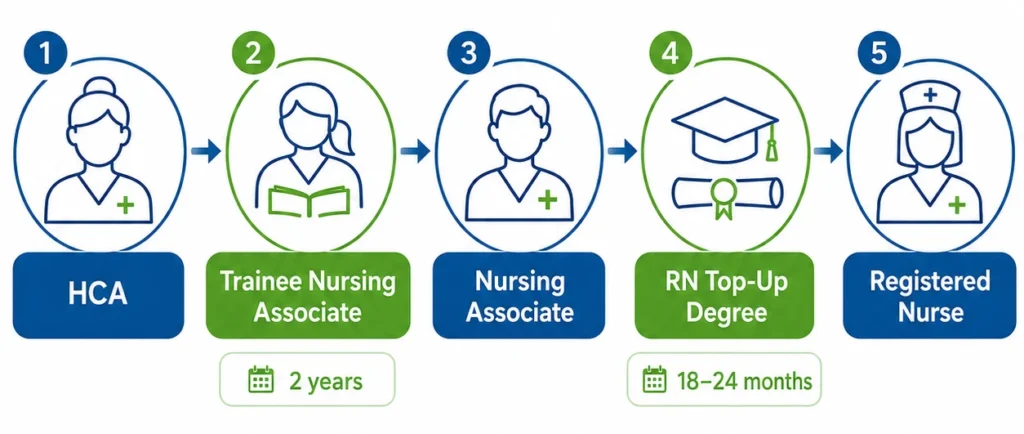
Healthcare Assistants can progress to Nursing Associate by meeting the entry requirements, completing an approved Nursing Associate training programme, and registering with the Nursing and Midwifery Council (NMC). This structured career pathway helps you develop advanced clinical skills, take on greater responsibility, and work as a registered healthcare professional. It also allows you to earn while you train through the apprenticeship route in many NHS organisations and creates a clear pathway to become a Registered Nurse in the future if you decide to continue your career.
Read on to understand how to qualify as a nursing associateand prepare for the opportunities ahead.
Table of Contents
Understanding the Role: HCA vs Nursing Associate
You already know what an HCA does, because you’re living it. You support patients with personal care, take observations, assist with meals, and keep things working smoothly, as it’s hands-on, essential work. But what is the role of a Nursing Associate, and how does it differ from where you are now? A Nursing Associate sits a step above that. You’ll take on more clinical responsibilities, things like administering medication, carrying out clinical procedures, and contributing to care plans. You sit between an HCA and a Registered Nurse, and you’re accountable to the NMC (Nursing and Midwifery Council) as a registered professional.
Entry Requirements for the Nursing Associate Program
Before you map out the journey for the nursing associate route, you need to know if you’re ready to take the first step. The entry requirements are more straightforward than most people expect. Here’s what you’ll need.
1
Work experience: Before the paperwork side of entry requirements, it’s worth asking what skills do nurse associates need? Patient communication, adaptability, and the ability to work across different care settings. Sound familiar? Because your role as a Healthcare Assistant already builds most of those skills every single day. Most programs ask for at least a year of NHS or health and social care experience. As an HCA, you’ve likely already got this.
2
Qualifications: You’ll typically need GCSEs (or equivalent) in English and Maths at Grade C/4 or above. But if you don’t have those formally, Level 2 Functional Skills in English and Maths can work as an alternative.
3
Employer support: Employer support can make or break your application, so treat it as a priority, not an afterthought. Since most people come through the apprenticeship route, your NHS Trust needs to sponsor your place. So, share your career goals with your manager and ask about the internal TNA application process and when the next cohort is due to start. If your employer doesn’t currently offer sponsorship, negotiate with them. Otherwise, consider applying to an NHS Trust or healthcare employer that actively sponsors Nursing Associate apprenticeships.
4
Academic Ability: You’ll also need to show you’re ready for a Level 5 academic study foundation degree. An NVQ or QCF Level 3 in Health and Social Care gives your application real weight; it shows your employer and the university that you bring both the academic preparation and the commitment this programme demands.
If you’re ticking most of those boxes, you’re in a strong position to apply. And no doubt these requirements will clear your confusion about how to progress from a healthcare assistant.
The Training Pathway: What You’re Actually Signing Up For
If you’ve been asking yourself how to become a nursing associate in the UK, here comes your satisfied answer. The programme itself is a two-year Foundation Degree (FdSc), and most healthcare assistants go through the Nursing Associate Apprenticeship (Level 5) route. Here’s what that looks like in practice:
1
50% theory, 50% practice: Half of your time is spent on academic lectures, assignments, and online learning through the university. The other half is practice placements across different clinical settings. You’ll see more than just your home ward.
2
You stay employed: On the apprenticeship route, you keep your job and your salary while you train. Your employer and the government cover the training costs through the apprenticeship levy. You don’t pay a penny in tuition fees.
3
It’s university-level study: Let’s be honest, the academic side is a step up. You’ll write essays, sit assessments, and engage with evidence-based practice. It’s manageable, but it takes commitment.
What Training Actually Looks Like Day-to-Day
So, this is where people sometimes underestimate what they’re taking on. Let’s be real about it. During your two years, you’ll rotate through different practice placements. That means you might spend time in community care, mental health settings, or different care settings outside your usual comfort zone. Interestingly, it broadens your clinical picture, and most people find it genuinely valuable even when it feels uncomfortable at first.
On the other hand, academically, you’ll have a practice supervisor and assessor supporting you in clinical settings, and a personal tutor through the university. Nobody leaves you to figure it out alone. But the challenge most trainees talk about? Balancing everything. Shift work, assignments, and family life- everything stacks up. The people who do well tend to be the ones who plan, use their support systems, and don’t leave the essays until the night before the assessment.
Registration with the NMC
Here comes the final moment. Once you complete the programme (and pass your end-point assessment on the apprenticeship route), you can apply for registration with the NMC as a Nursing Associate. Honestly, this is a big deal. More than 5,500 Nursing Associates are already working across the NHS, and you’ll soon be eligible to join them as a registered professional. You’re now a registered professional with a PIN and also bound by the NMC Code of Conduct. Fortunately, your scope of practice expands, your accountability increases, and your nursing associate salary reflects that, usually moving to Band 4 on the Agenda for Change scale with £22k – £27k/yr. It’s the moment where everything you’ve worked for becomes official.
What Comes Next: Progressing to Registered Nurse
A lot of Nursing Associates don’t stop here, and you don’t have to either. Once you qualify and register, you can pursue an NMC-approved top-up degree and take the next step towards becoming a Registered Nurse. Because of your Nursing Associate qualification and your prior learning, you won’t start from scratch; many programmes are 18 months to 2 years rather than the standard three. So the full journey looks something like this:
Your Progression Starts With Your Foundation
Becoming a Nursing Associate doesn’t begin the day you decide to progress from healthcare assistant to nursing associate and submit your application. It begins the moment you decide to take your development seriously. The strongest candidates coming into the programme are the ones who’ve invested in themselves as Healthcare Assistants first and filled their skills gaps.
If you want to be that candidate, Healthcare Academy (HCA London) is your starting point. Our healthcare courses are tailored for healthcare assistants like you. You will develop professional confidence, improve your skills and boost your CV to not just build a strong foundation but prepare yourself for future roles.